1/13/17
Case 5 of the Mumonkan
Mumon, Wu-men Hui-hai (無門慧開), the Chinese Ch’an Master says, "If you can respond to this dilemma properly, you give life to those who have been dead and kill those who have been alive."
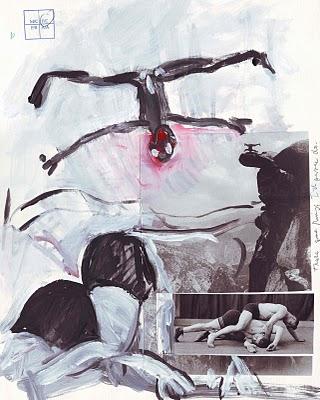
Here is Case 5, "Hsiang-yen: Up Tree."
The priest Hsiang-yen said, "It is as though you were up in a tree, hanging from a branch with your teeth. Your hands and feet can't touch any branch. Someone appears beneath the tree and asks, `What is the meaning of Bodhidharma's coming from the West?'”
If you do not answer, you evade your responsibility. If you do answer, you lose your life. What do you do?"
______
It has been at least 6 years since I took up the case. I told another story about Hsiang-yen in a piece I wrote about a difficult and wonderful conversation that I had with my mother a few months before she died ("The Gift of Tears"). Hsiang-yen must have been an immensely gifted teacher if he continues to inspire others to be honest and human more than a thousand years after his death.
Today I find myself totally swept up in the hanging man's dilemma as I begin to re-work Step 1 of the 12 Steps. The Big Book of Alcoholics Anonymous puts the first step in simple, straightforward language: "I admit that I am powerless over [alcohol, drugs, food, sex]—that my life has become unmanageable." It's just the first step on a journey, and there is a story connected with my personal surrender.
Even if I'd never heard of Bodhidharma, there are questions in my life that I can't evade—my life depends on my answer. It might not be entirely clear to a 21st-century reader that the question about Bodhidharma coming to the West carries enormous weight for anyone practicing with a Zen master. My answer unlocks the wonder of practice and the Buddha Way.
At my first 12 Step meeting, when asked, "Are there other alcoholics/addicts present?" I automatically said, "Yes." I didn't grasp that the question was a life or death issue, that it carried all the weight of the person hanging by his or her teeth. I certainly didn't realize that it would turn my world upside down. I was about to learn that answering it truthfully meant that I was about to lose a life I'd become comfortable with, a life of deception I loved in a weird, perverted way. I'd learned to talk my way around my addiction so well that I even believed its lies.
I had been practicing meditation for decades, but I missed the immediacy and urgency in that question—right now, right here, people in this room were suffering real biological and psychological effects of drug and alcohol abuse. If I'd been paying closer attention, it might have been easier to see the delusions I'd have to give up, and admit that I'd lost control of my life, which is the baseline for any real conversation about sobriety. Another question follows an honest yes: could I examine the roots of my addiction clearly and move beyond denial? My sponsor was very direct: “Cut the bullshit and get real.” We all need real friends we can talk with, men and women who leave any pretense at the door.
Both the spirituality of the Big Book and Zen, I think, start from the same place: what in my experience got me stuck? It’s my dilemma, not the person on the cushion next to me, or the homeless guy stinking of urine on the bus that I can’t move away from. In Zen, I am never asked to believe anything outside my own experience, not even for a split second.
What transformed this question for me from an intellectual consideration about the nature of addiction and alcoholism to one with all the force of Bodhidharma's coming to the West and facing the wall for 9 years in meditation? My roommate committed suicide, and I found myself hanging from the branch by the skin of my teeth.
I came home to discover my roommate's bloated body had been dead for at least three days. Just the smell of the house was overwhelming. The shock sent me spinning emotionally and psychologically. The police and medical examiners suggested that I call a friend. The man I called came right over, put an arm around my shoulder, and listened without any judgment to whatever came out of my mouth as they carried Dean's body down the stairs.
My response was to lapse into an uncontrolled rage of using drugs and drinking. As I look back over those few days and weeks, Ash proved the depth of his friendship: he wouldn't allow me to play the victim, "Oh, you poor guy, how horrible!" or indulge any self-importance or fake heroism to let myself off the hook. He told me that even if I was just a guy who happened to be standing by when a tragedy unfolded, I still had to clean up the mess before I could move on. I had no other choice if I was going to choose life. He encouraged me to face the circumstances without drama and get it done. And he took me to a meeting. Friends don't get any better.
A long meditation practice follows me into the 12-step work, not as baggage but as a friend. When I listen to someone in one of the rooms coming to terms with the concept of a Higher Power, having been told that his or her program depends on acknowledgment and surrender to Something greater than the self, I can only admire the struggle and right-mindedness of their effort. My own experience was very similar. At some point, the practice of meditation, or maybe just growing older with more life experience, I dismantled most of the conceptual notions I had believed and put my trust in, but what replaced it was a far more intimate sense of how I am, at the core of my being, connected to the profound inner workings of the universe.
And even though my own inner experience started to become clear only after long hours on the meditation cushion, I know that this path is open to anyone, even in the blink of an eye. So meditate. Just do it.
The instructions to enter the koan’s world are really quite simple: Sit down, straighten out my spine so that I can stay awake and alert, focus on my breath, pay attention. That’s enough meditation instruction to get started. Then, as I settle in, if I choose, I can get real about how I respond to Hsiang-yen’s question, what do you do when you're hanging from a branch by your teeth? My life depends on my answer, where, really, no kidding, I'm going to fall into an abyss when I open my mouth. I don’t believe anything, not even for a split second, that I have not experienced myself, but I have also come to trust, thanks to my teachers and my own experience, that the koan will shake an honest answer loose.
Perhaps our answer allows us to simply fall into the unknown and follow the example of the trees' own leaves in the Fall. Thank you, Lucille Clifton, for the capping verse:
The Lesson Of The Falling Leaves
the leaves believe
such letting go is love
such love is faith
such faith is grace
such grace is god
i agree with the leaves