"This May be Heresy, but I don't care."
A reformulation of the “Particular Examen” in Saint Ignatius’s Spiritual Exercises
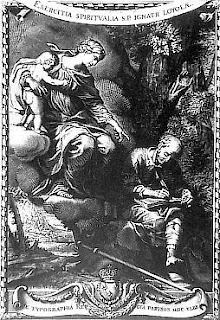 |
I intend to explore the possibility that Saint Ignatius's Examination of Conscience, the Examen, might be useful as a rigorous way to focus our inner search. It’s an Open Source for anyone who wants to lead a full life in their communities and the universe. It’s probably not for individuals who confine themselves to a predetermined set of rules or conventions about behavior, love or faith, and don’t welcome questions. Leave that to the True Believer.
I hesitate to edit Ignatius. He was not an atheist or a non-theistic hidden Zen master. His Exercises, however, spring from inner experience, prayer and meditation, and I want to test the hypothesis that they hold up outside Catholic theology. I have removed references to a deity, or to any external guidance not because I denigrate a particular belief, but I trust most believers can quickly fill in the blanks. Leaving them open might also allow space for new understanding or insight. In places I have left the words “faith,” “love,” “grace,” “presence,” “guidance,” and “goodness,” not as absolutes but rather focus points. Look for faith and presence in our lived experience instead of returning to old sermons about how to behave and be good. Examine our inner landscape. Include emotions, memories, and dreams. Think with every part of ourselves, right down to the bones,
Ignatius recommends undertaking the Examen for a relatively short period of time, 10-15 minutes, at three distinct times every day: upon rising, before the mid-day meal, and upon retiring. In the morning, as your day is not yet filled with conscious and unconscious actions, you resolve to reflect and remember what you are going to look for if you have identified a ‘chief characteristic.’ Usually you will hone in on what you’ve determined is your greatest obstacle to living in freedom and love--some trait, a repeating negative pattern, a persistent inner dialogue, resentment or prejudice. This becomes a tool that helps focus your review of the day’s events. It is almost always a moving target. You might work with a spiritual director to figure out a useful self-interrogation.
Here are the steps of the Examen*
Quiet yourself. Become aware of the simple goodness of the universe. We see the gifts of life, the blessings of this human world through faith, the eye of love. Be thankful.
Look within to see clearly, understand accurately, and respond generously to what is occurring in our lives.
Review the history of the day (hour, week, or month) in order to see concrete, specific instances of the influence and activity of what we have identified as our chief characteristic. These can be detected by paying attention to strong feelings that may have arisen in situations and encounters. Over time more subtle feelings will become apparent.
Examine these instances, our actions, reactions, words and feelings to see whether you have collaborated with deep inner guidance or yielded to the influence of evil in some way. Express gratitude and regret.
Plan how to use our own inner guidance skillfully to avoid or overcome the negative influence of the chief characteristic in the future.
November 16th, 2006
The Examen was a breakthrough in the pedagogy of prayer. Human beings are certainly capable of self-examination, and Christians can find inner peace and clarity without Ignatius’s guidance. But he did recommend a method of prayer radically different from the ritual of confession and penance (although he certainly didn’t exclude them). He crafted a way to examine our inner landscape, the particular set of inner motivations and proclivities that govern our lives, and then refocus with an intention that we set for ourselves.
Many people believe that prayer is like “talking with God,” and that it is the most natural of any communication. I don’t believe this is even close to the truth. For Christians it would mean that the results of Original Sin magically disappear with baptism or conversion. This is not supported by most of what we can gather from the records left by mystics and saints, and it certainly flies in the face of most Eastern teachings regarding humankind’s sleeping, inattentive, deluded state.
If God actually speaks to us, how do we know that our own channels are not jammed with well-intentioned instruction and misinformation at best or unexamined prejudice and obfuscation at worst? I recently saw some clips from a TV documentary called “Camp Jesus” about a fundamentalist summer camp for children. After the adult woman leading a prayer group made the rather startling accusation that Harry Potter should be in Hell, there was an interview with a young 12 or 13 year old boy who was a preacher. The boy said with absolute conviction that he regularly talked with God about his future, but when the camera switched to his father, also a preacher, and I began to listen for the subtext of what the father said, I felt that a strong, irrefutable case could be made that his son's “godly” conversations were nothing more than interiorization of subtle and overt parental messages and prejudices. I am certain the kid believed that Harry Potter was hell bound, and sadly he was destined to be just like his dad.
Prayer has to be taught and learned. How it is taught changes. We learn about love as we live out our lives; we share, and try to teach our children, from our experience. This learning cannot happen in a vacuum: my friend Daniel Shurman refers back to this phrase from Episcopalian liturgy: what is the Spirit saying to the Church? We are always listening and learning, both from the Source of All That Is and from one another.
After filling the page with distillation of Ignatius and reflections, I remember the caution of a very astute Jesuit spiritual guide: “Our capacity to deceive ourselves is infinite!” This leads to another set of cautions: don’t be duped and fall for an easy answer, but on the other hand, don’t let this caveat become an excuse to give up your quest when you become discouraged because you certainly will. Stick with it.
__________________
Notes
It was very difficult to find the exact text of Ignatius for the Particular Examen online. The internet is flooded with many people using the header “The Examen of Saint Ignatius,” and then freely adapting them. I have lots of company; whether or not it is good company, the jury is out. While my adaptation is admittedly one of the most theologically extreme, I have explained at some length my reasoning, and include an English translation of the original text from The Spiritual Exercises.
*The text:
The first point is to give thanks to God our Lord for the gifts received.
The second point is to ask for the grace to know my sins and to root them out.
The third point is to demand an account of my soul from the moment of rising to that of the present examination, hour by hour or period by period. The thoughts should be examined first, then the words, and finally the actions.
The fourth point is to ask pardon of God our Lord for my faults.
The fifth point is to resolve to amend with the help of God’s grace. Close with the Lord’s Prayer.
My conversation deals with the Particular Examen, and the text from the Exercises is specifically for what is known as the General Examen. The steps are the same for both. The general examination surveys all the morally significant actions of the day, so far as we can recall them, while in the particular examination we focus our attention on one particular fault against which we are struggling and the corresponding virtue we are trying to cultivate.
From The Spiritual Exercises of St. Ignatius Loyola. Edited by Fr. Martin Royackers, S.J.
__________________
The woman who inspired this essay, Annemarie Marino, died on May 20, 2006. I will always remember her bright mind and generous heart. We had wonderful conversations. Please add your prayers to mine that she has found peace and her heart's desire.
I invite anyone who reads this and wants to comment or share something about their experience using the Ignatian Examen to leave a comment or contact me. If you are interested you can also check out the wide selection of books, articles, and websites that Morgan Zo-Callahan and I put together, An Ignatian Bibliography.


