Search This Blog

Thursday, May 16, 2013

Sonja Margulies Roshi and a note about Dharma Transmission


Sonja Fenne Margulies (March 7, 1931 - May 5, 2013)

Sonja Margulies-Fenne began Zen practice in 1968, was ordained in 1975, and received dharma transmission from her teacher Kobun Chino Roshi in 1983. For many years, she was the co-editor of The Journal of Transpersonal Psychology.


May 15th, 2013

I just received word that Sonja Margulies-Fenne died in Salt Lake City, where she had moved to be with her son, Peter. She was 82.

Her Zen teacher, Kobun Chino Roshi, gave her a stick in 1983. She told me the story about her dharma transmission that might fit into the current conversation about authentically authorized Zen teachers. She had been practicing for about 15 or so years with Kobun, who taught at SF Zen Center with Suzuki Roshi, and he—Sonia’s words—wanted to cut the umbilical cord and allow her to stand on her own feet. She resisted for one reason or another, and, as she told me, they went back and forth, and back and forth, reaching a kind of koan quality, “What do I do with this one precious life of mine?”

At the end of one sesshin, during her exit dokusan, again they talked, and once again, seemed to arrive at no solution that satisfied her. (I think that Sonja was telling me, just like she told Kobun, that she didn’t want to give up her life on the beach in Santa Cruz, her writing, her poetry, her interest in psychology, and especially the cozy conversations with friends and her daughter Robin). So she got up and bowed to Kobun just as any good priest would honor his or her teacher. As she turned around and put her hand on the doorknob, Kobun called out, “Sonja!” When she turned her head, he threw his stick at her. No time to think, she reached out and grabbed it.

Although she did many things expected of a Soto lineage holder, she remained very low key. Her practice center was the living room couch in her simple Santa Cruz beach cottage. Her teaching never lost the tone of a cozy conversation. And the depth of her love for the dharma shone through her self-care when she survived breast cancer and the care she gave her daughter, Robin, while she died from cancer. Beyond words.

She was a wonderful woman and an inspiring teacher.

Local News: Poems by Sonja Marqulies

Lenore Friedman wrote about Sonja in Meetings with Remarkable Women: Buddhist Teachers in America

Thursday, December 13, 2012

Sister Kuon Elaine MacInnes Roshi

 Originally posted December 12th, 2012

“Spirituality is what you do with those fires that burn within you.” -Sister Elaine


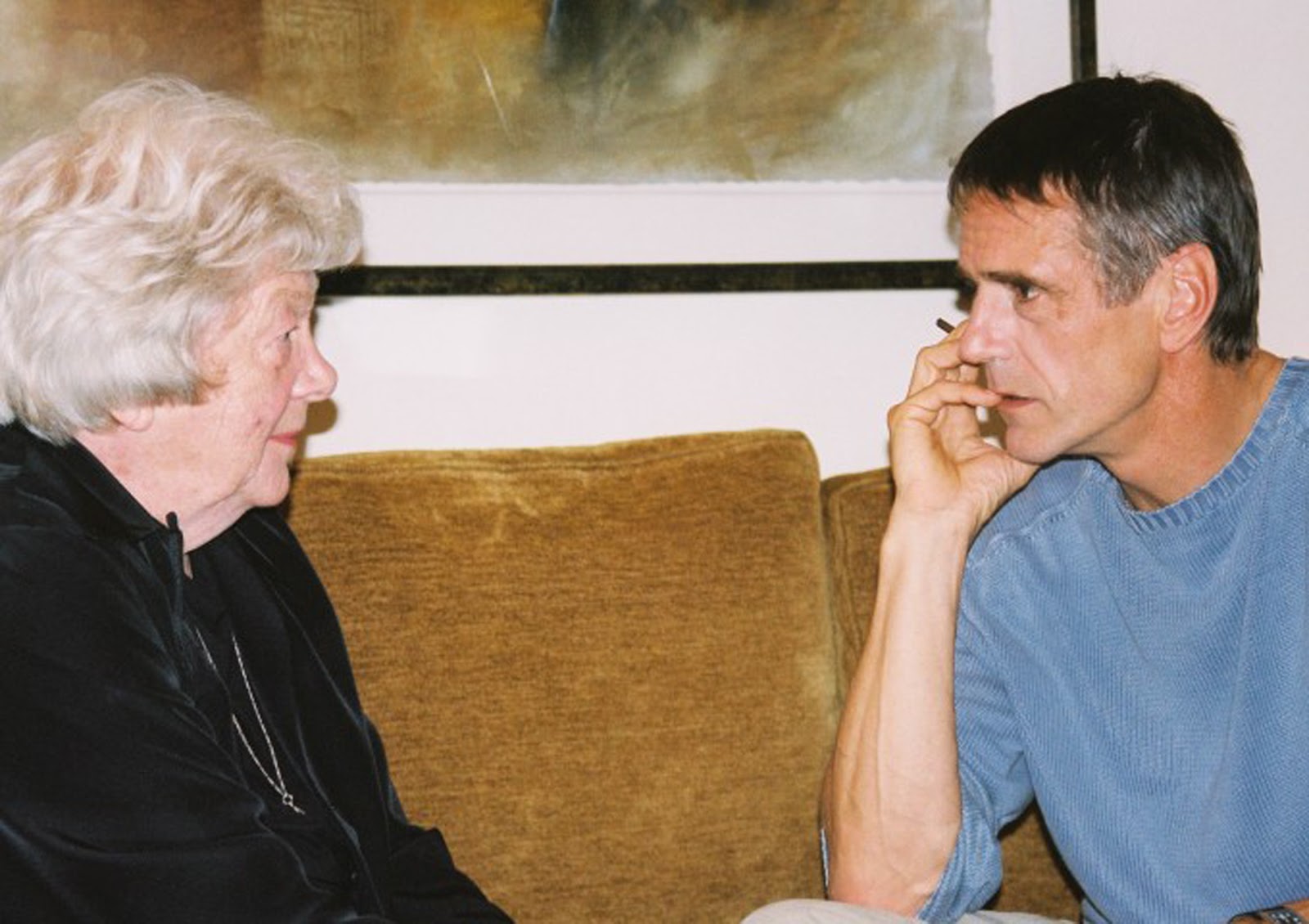
Sister Elaine MacInnes is a Catholic nun and a recognized Zen master. I have included a brief biography, a film, The Fires that Burn, done about her, and a link to her book on the miscellaneous koans. The picture of her with Jeremy Irons dates to her tenure as head of the Prison Phoenix Trust, which she founded to introduce meditation into the UK prison system. Now in her 80’s, she continues to work with prisoners in Canada through the not-for-profit Freeing the Human Spirit, which she founded.


not broken, what do catholicism, Zen, yoga & prisons have in common? A Profile of Sister Elaine MacInnes by Talya Rubin

The Fires that Burn explores the life and work of Sister Elaine MacInnes - professional musician, Roman Catholic nun, Zen master, and prison activist - and her unusual journey to greater understanding. The documentary retraces 80-year-old Sister Elaine's life path of spiritual redefinition and uncovers the journey from her harrowing days as a body shield and activist during the civil war in the Philippines to her present-day campaign to bring meditation teachers into prisons across Canada.

Flowing Bridge, Guidance on Beginning Zen Koans, By Elaine MacInnes. Elaine Roshi took some flak for writing about a koan practice that had been almost entirely an oral tradition, but I see it as her simply starting from the beginning.

Saturday, January 14, 2012

"Mindfulness is Not a Part-Time Job," a talk by Issan Dorsey

A Dharma talk given by Issan Dorsey Roshi
Originally posted on 1/13/2012

This transcript appeared in the newsletter of the Gay Buddhist Fellowship in January of 1995, four years and five months after his death from AIDS.


From Allen Ginsberg's collection


Someone said to me the other day, “Aren’t you always working on something?” Yes, we are always working on something, but hopefully it’s not up here in our heads, filled with words to obscure it. I was talking with a friend recently about the phrase, “coming to reside in your breath-mind,” and working with the phrase, and how useful it is to me. I thought it was interesting that I’d never really heard it before, and was just now beginning to work with it. I realized that I actually just heard it deeply.

This has been with me since I first started practicing. It’s a whole way of working with your mind—and I’ve been thinking a lot about it lately. I hope you won’t have to wait for 20 years before you begin to hear how to work with this thing called the mind in your zazen meditation.

Now, people who come to practice immediately sit much more easily than they did when I first began to sit at Sokoji Temple years ago. I remember everyone sitting with their legs bent up. They’d sit for five minutes, then they’d lie down and moan. But now people come, and it’s like we already did that part for them. It’s as if we have a shared body that has already gone through that preliminary stuff, and people are already able to experience some aspect of zazen practice and how we practice together.

We have to be willing to explore and experiment. First, we have to have a sense of humor and a willingness to explore and experiment with our lives and our discomfort. We know that sometimes we can sit for a few minutes, or even a few days, and at some point it gets pretty uncomfortable, and it’s uncomfortable for us not to invite our thoughts to tea, and reside in our breath-mind.

“Don’t invite your thoughts to tea” is an expression of Suzuki-roshi’s, which I’ve always found useful. You know these are just words, and we have to remember that every human concept is just delusion. Still, we use words and provisionally talk about our experience. Lately I have been exploring this way of thinking with a friend who has AIDS dementia; the virus is living in his brain. I’m thinking and working on it and talking with him about it because the virus that is attacking so many of us now ends up being in the brain. So is there some way for us to experience that? I don’t know yet. My question is: how to be with people who have dementia and how to experience the dementia that we all have anyway? It’s called delusion. Mind is always creating confusion, joy and pain, like and don’t like, and depression. But there is also a “background mind.” That is what my friend and I have been discussing.

Sometimes when I’m talking about uncomfortableness, I talk about the five fears. One of the five fears is the fear of unusual states of mind. How can we come to have appreciation and respect for this fear and not just some resistance, so that we can enter our fear, allowing these new areas of uncomfortableness? When we can enter each of these new spaces, we can begin to look at truthfulness.

Why do we have to sit? Really there’s no reason to sit. If we’re completely sincere, then there’s no reason to sit. I’m not completely sincere so I have to keep sitting to check. Even if we’re involved with unskillful actions, the one quality we should strive for is truthfulness. Truthfulness takes a total commitment to see all aspects of ourselves and our unskillfulness. If we can embrace the totality of ourselves, we can embrace the totality of others and of the world. Our tendency is to think about things before we do them. Even when we see a beautiful flower, we say, “Oh what a beautiful flower.” “Beautiful flower” is extra. Just look at the flower with no trace.

Suzuki-roshi wrote, “When we practice zazen, our mind is calm and quite simple. But usually our mind is very busy and complicated, and it is difficult to concentrate on what we are doing.” This is because when we act, we think, and this thinking leaves some trace. Our activity is shadowed by some preconceived idea. The traces and notions make our mind very complicated. When we do something with a simple, clear mind, we have no shadows, and our activity is strong and straightforward.

So, even with zazen practice, it gets so complicated. We’re dissecting every aspect of what’s going on, reviewing and comparing. How do we keep it simple and straightforward? How do we come to know this basic truth of practice and Buddhism? The teaching and the rules can and should change according to the situation and the people we’re practicing with, but the secret of practice cannot be changed. It’s always true.

We teach ourselves and encourage ourselves by creating this space, the meditation hall, so we can begin looking at our minds. “Don’t invite your thoughts to tea.” “Where is your breath-mind?” I used to say, allow this kind of mind to arise. But now I’m saying create background-mind.

This practice is simple: watch your breaths and don’t invite your thoughts to tea. But not inviting your thoughts to tea doesn’t mean to get rid of thinking. That is discrimination. So, there’s no reason to get rid of thoughts, but rather to have some blank, non-interfering relationship with them. Don’t make your mind go blank; rather, have a blank relationship with your thoughts. Begin to see the space behind and around the thoughts, and shift the seat of your identity out of your thoughts and come to reside in your breath-mind. We develop our intention to reside in our breath-mind by first bringing our intention to “breath as mind,” and then by shifting the seat of our identity from our thoughts to our breath.

This all ties in with how we use this space, this laboratory. We should have a willingness to explore with our lives, and this is our laboratory right here—how we use the meditation hall and how we use what happens outside of it. Mindfulness is not a part-time job.

If you want to see more about the life and teaching of this remarkable man, please visit my page: "The Record of Issan."