Monday, August 19, 2024

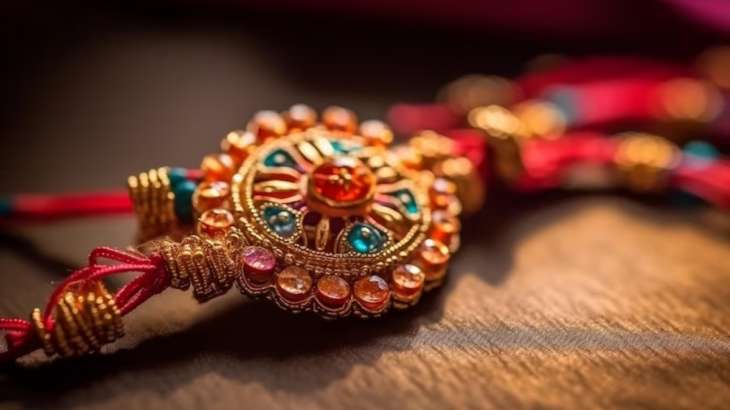
Raksha Bandhan


Tradition bids me tie a ribbon on your wrist 

To say that you and I are related,

And it will always be

No matter what

What husband, what wife, 

what daughter, what son,

What lover, what friend,

May kisses, caresses

Abound.

May wounds be few.

No matter,

There will be love.


What prizes and honors won, 

Include the ones you lost,

What joy, what laughter, 

what grief, what loss,

What trouble, what pain, 

what fear, what tear, what discovery, 

Embrace it freely.

In this moment

You are my world.


We are blood and yet so different

It makes no difference

What barrier, what fence

What wall, what boundary.

Cross, venture, explore,

A postcard now and then might be nice.

Calls are also cheap these days,

But neither is required.

I know there are only so many 

Seconds, minutes, years granted to us.

Use them as best you can.

As best we can.

I will try.


Make mistakes,

I will join you.

We are forgiven in advance.

You are encouraged to make as many as possible 

Unharmed or even injured.

Try to stay safe.

Continue please. 

You encourage me.


Forgive me if I have hurt you.

It was not intentional.

I know that I can be blind and careless.

You are also forgiven.


The world as we find it

Is a blessing.

You are part of my world.

Sounds trite

But it’s true.


Raksha Bandhan 2023


Thursday, August 15, 2024

Reflections on the Feast of the Assumption

Mary, Mother of Jesus, Mother of God, pray for me, a sinner.


The traditional vow days in the Jesuits are feasts of the Virgin Mary, today, August 15th, and September 8th, her birthday. I took my simple religious vows on September 8th, 1968. It was common for most young Jesuits to take Mary as their “vow" name. So I might have said, “I, Kenneth Maria Ireland, vow to your divine Majesty, before the most holy Virgin Mary and the entire heavenly court, perpetual chastity, poverty, and obedience in the Society of Jesus.” I asked to keep my given name, and it was granted. 


As far as my Marian faith goes, I am a pretty stripped-down, basic gospel kind of guy. Some of this can be traced back to my Calvinist heritage; my father was a Yankee free thinker, and there was some rebellion against the rigid Irish nuns who taught the Baltimore Catechism by rote. I have zero desire to make a pilgrimage to Fatima or Lourdes. Apparitions are far too spooky for my rational mindset. I’ve always held that Mary's “Dormition” is far more palatable than her bodily transportation to the Gates of Heaven. I prefer myth when it comes to such matters. The infallible pronouncement of Pius 12 happened when I was 8 years old; even then, I wondered how something this momentous could be hidden and unrecognized for such a long period of time. I said the rosary every day when I was in a Jesuit house of formation. We all did. I liked the repetition of the words of a simple prayer and the contemplation of the mysteries I took to be more like visualizations of scenes from the stories told in Matthew, Mark, and Luke (John is a bit too gnostic). 


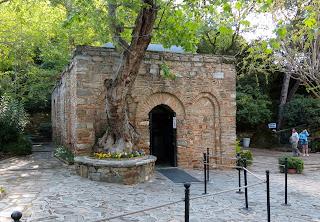
By Erik Cleves Kristensen - House of the Virgin Mary


When Ashish and I visited Ephesus, after tromping through the amazing Roman ruins, we took a small jitney several kilometers high up into the bluffs overlooking the ancient harbor to what is known as Mother Mary’s House. According to legend, Saint John, the gnostic one, took Mary to the small community that Paul had founded in that Roman colony after the death of Jesus. She was to spend the rest of her days protected from the turmoil of James’s Jerusalem Church. Of course, her presence also legitimized the ascent of the Jesus congregations of Greeks and Romans who were not observant of Jewish law and customs, but I will leave that side for polemicists to hash out.


When I got on that small, rickety bus, it had been more than 35 years since I left the Jesuits and 30 years of practicing Buddhist meditation. I’m just giving some background about the mindset of the guy who headed up Mt. Koressos (Turkish: Bülbüldağı, "Mount Nightingale") to the place that Saint Anne Catherine Emmerich had seen in visions as Mary the Virgin's last earthly abode.


It fit the parameters of a place that I could envision for the house of Mother Mary. Being there was wonderful and peaceful, with a genuine feeling of the Transcendent. No throngs of the faithful seeking miracles, no massive basilicas commemorating a Saint’s vision, no sellers of Marian trinkets and memorabilia. There were perhaps a dozen religious women, maybe less, quietly tending simple gardens and very austere shrines. We wandered wherever we wanted and stopped when we felt the urge. No one exhorted us, telling us what to believe or how to pray. There were few votary candle boxes like the ones I remember from the Irish parishes of my youth in front of Saint Mary’s statues. There was only one donation box near the exit.


I felt a real sense of freedom when I boarded that rickety little bus for the scary ride back down to Selçuk. I had been in the presence of the Virgin, and my mind was allowed the space to take whatever tack was appropriate for the time and place.


Friday, August 9, 2024

Eucharistic Flop, a lifeless, bloodless sacrilege

Why the Eucharistic Congress was not just a costly, meaningless show but a sacrilege: many of my ex-Jesuit friends fault it for being an anachronistic diversion from the nuts and bolts, tedious work of Tikkun, repairing our torn and frayed world with poverty, migrants, homeless people, misfits, fundamentalist racists, children murdered in Gaza and Ukraine, conscripted soldiers slaughtered, terrorists assassinated by high tech missiles that can find your bedroom window. The list seems endless. Worse for the activists is the fact that it seemed to be orchestrated by an increasingly right-wing leadership in the American Church as a counterpunch for what they see as the activist agenda of the liberal Jesuit Pope. 

All those cogent reasons are, well, very cogent and appropriately political. What better way to shore up the memory of our forgotten religious life, where the priest was god's representative, and we faithful cowered in pews on the designated night and sang “Tantum ergo Sacramentum,” not having a clue that Thomas wrote those words after he had the experience of seeing all the hundreds of thousand words of very cogent theology disappear like so much straw and less idea of what any of it meant. I loved singing genitori genitoque, especially when we got to procedenti ab utroque, meaning that any meaning came from somewhere else, and I had no idea where, although that was a bad translation. But in general, now that my Latin is better than before a Jesuit education, I find the whole affair poorly conceived from somewhere else.


I was saddened by the silly parades, with thousands of altar boys in black and white, priests in white and gold, and bishops in lots of gold and big hats, stumbling along with no sense of what a religious procession might look like. They might have been trying to be regal and dignified, but actually, the volunteer fire department does a better job marching behind their red trucks on the 4th of July than these school boys could muster behind the crudely decorated trailers that were being dragged by the best trucks that the diocese could borrow from the Knight of Columbus who had a concrete company. Firefighters have a purpose. A New Orleans funeral marching band has a purpose. These jokers were doing something that they had been ordered to do. That seemed to be their only purpose.


The problem for me, however, goes beyond the aesthetics of mounting a religious festival with the obvious political agenda of lending support to an anachronistic, monarchial church of yesteryear. It is in the trivialization and even commercialization of God’s Presence. If I can be bold, even Thomas missed this. We are not worshipping a thing, a piece of flat, tasteless bread that has been magically changed by uttering magic words. When I bow before the Great Sacrament, I bow to the Presence of God. It is present, it is immediate, it is transformative. Instead of a flat, lifeless speck of white carbohydrate, it is love, intimacy, and mystery. All that got lost, not just lost in the sense that there was a piece missing and we knew that something was missing. It was lost in the sense that the ceremony didn’t even point to that Great Presence that is with us but invisible to our ordinary senses. Maybe Thomas, you did get it--Sensuum defectui..


And how much money did this farce cost?