Of course it helps if you’re devoted to musical genius of Queen as well as the Enneagram.
Rivers Crossing is a church?
[I am posting this article by Subhuti from the Osho News. I found it very interesting.]
Subhuti writes in detail on how a method for enlightenment ended up in court. “The Enneagram’s deepest value lies within the context of meditation. That is the turning point, at which self-understanding becomes spiritual transformation.”
Leaving Arica for Pune
By the time the bullets started flying, I had left the battlefield. I had bid farewell to Oscar Ichazo, creator of the modern Enneagram system. I had written a bitchy letter to his staff at the Arica School in New York, arrogantly informing them I was no longer interested in being an Arica trainer and was off to India to complete my spiritual education.
This was 1976. A couple of years earlier, I’d been an enthusiastic, gung-ho ‘Arican’. I was convinced Arica was going to save the world. Oscar had warned us of a great darkness that was about to fall on humanity and we, as little Arican light bulbs, would be its shining saviours.
Nice, spiritually romantic idea. But there were a few problems: First, the darkness didn’t fall. Second, humanity wasn’t interested in being saved. Third, the light bulbs didn’t work. So, when an old girlfriend of mine came back from an ashram in Pune, India, wearing orange clothes and glowing with energy, I was ready to be seduced. Just kissing her was an orgasmic experience.
If she hadn’t been leaning out of a train window while I was standing on the platform, and the train hadn’t started moving, I think we’d still be kissing today. Anyway, I received her energy transmission. I got the message, passed from mouth to mouth: something wonderful and slightly scary was going on in Pune. I had to go and check it out.
A few weeks later, when I arrived at the ashram, I sat in front of Osho and he asked me how long I was going to stay. I heard myself reply “For ever.” Ooops! I hadn’t meant to say that, I still don’t know why I did, but it turned out to be true. I’d found the door to shunyata, divine emptiness, as well as sexual liberation, ecstatic celebration and chaotic meditation.
The combination was irresistible.
Fourteen years and many adventures later, I was sitting in the Pune ashram’s cafe, drinking a cup of chai, when someone handed me a book titled Enneagram: Understanding Yourself and the Others in Your Life, by Helen Palmer.
“My God, I used to teach this stuff!” I exclaimed, thumbing through Palmer’s detailed description of the Enneagram’s nine personality types.
“Why don’t you teach it here?” asked the book’s owner. So I got together with another ex-Arican, who’d conveniently kept all his notes, and we did.
The legal battle between Helen Palmer and Oscar Ichazo
Meanwhile, back in New York, Helen Palmer and Oscar Ichazo were locked in a legal battle that went all the way to the US Supreme Court. It’s ironic that a method for enlightenment should become a cause for combat. But then again, when you look at the world’s religious history, it’s not surprising. So much blood has been shed in the name of spiritual truth.
The Arica Institute, with Ichazo’s blessings, accused Helen Palmer of copying his Enneagram doctrine and infringing his copyright, requesting the American courts to block distribution of thousands of paperback copies of her book. The courts refused, saying that copyright law did not cover most of what Ichazo was teaching. The secrets of the Arica school had escaped into the public arena.
Oscar was upset, Helen Palmer was happy and the Enneagram mushroomed into a New Age phenomenon, generating hundreds of ‘experts’, scores of trainings and dozens more books. In a way, it was Oscar’s fault. He should have published his own book back in the early 1970s, when he had the whole system to himself.
But, alas, the Bolivian-born mystic, whose native language was Spanish, had a complex and difficult way of expressing himself and was never able to write a decent book in his whole life. There was another, more profound reason, why Oscar was distressed. Whether his methods were effective, or not, Ichazo was a genuine mystic. He wanted to help people become enlightened.
He knew that the ego blocked the path to cosmic consciousness and believed that the Enneagram’s description of nine ego-fixation points could dissolve this basic obstacle. In other words, as Ichazo explained to us, if we could see the ego clearly enough, in its raw, naked form, it would collapse, opening an inner space for the manifestation of our Divine Essence.
Poor Oscar! He obviously had no idea how stubborn and adaptable the human ego can be. The ego is the all-time survival expert – I speak from personal experience.
Ego Plan, Type Seven
For example, when I was informed by an Arica trainer in New York that I was Ego Plan, Type Seven, my ego took a massive hit. For a while, I was in a kind of daze, shocked to my core at this revelation of how my ego functioned.
It was a powerful experience. But pretty soon, like other Aricans whom I knew, my ego had recovered from this knock-out blow, climbed back off the floor, and was again in business. After all, I had a new identity. Now I was an Arican, a Plan, feeling spiritually superior to the rest of our sleepy humanity and happily giving Enneagram sessions to everyone around me.
But, as I say, Oscar was a mystic and his intentions were good. He’d wanted to keep the Enneagram system secret, because he knew it worked best as a tool for ego-reduction within the intense atmosphere of a closed school.
Helen Palmer, on the other hand, was no mystic. She’d made sociological studies of the nine personality types, describing their difficulties and making suggestions how to smooth out the rough edges. It was the exact opposite of what Ichazo had intended. He wanted to destroy the ego. Palmer was telling people how to improve it.
But how did Palmer get hold of the Enneagram in the first place?
Come to think of it, how did Ichazo get hold of it?
Let’s back up and take a look.
Where does the Enneagram come from?
The Enneagram, as many people know, is an ancient symbol. It was brought to the attention of modern Europeans by George Gurdjieff, the Armenian mystic, who claimed it represented the laws of the universe. He used the symbol mainly in music and dance. He also asserted that every individual possessed a “chief characteristic”, but at no time did he mention nine personality types or try to relate these types to the Enneagram symbol.
Gurdjieff had visited many Sufi schools as a young man – documented in his book Meetings with Remarkable Men – so it was assumed he’d learned the symbol from them. Now it seems more likely that it was taught to him, as a boy, by his tutors, who were esoterically-inclined monks, belonging to the Greek Orthodox tradition of the Christian faith.
At this point, we find ourselves in historical regression, because the next question is: where did these monks get the symbol? They seemed to have inherited it from a group of early Christian mystics, living in Egypt, called the ‘Desert Fathers’, who may, or may not, have linked the Enneagram symbol to the so-called Seven Deadly Sins, adding two more for good measure, making nine in all: anger, pride, deceit, envy, avarice, fear, gluttony, lust and sloth.
This, however, is not the beginning of the story. The Desert Fathers, being mostly Greeks, may have picked up the symbol from the teachings of Ancient Greeks like Pythagoras, Plato and Plotinus. However, even if all this is true, Oscar Ichazo denied that he got the Enneagram symbol from Gurdjieff, so there was no clear line of continuity.
So, where did he get it? For a while, all kinds of exotic rumours buzzed around the Arica School in New York. My favourite one went like this:
Oscar had undertaken a dangerous solo pilgrimage through remote areas of the Hindu Kush Mountains, in Northern Pakistan and Afghanistan, meeting with secret Sufi schools and receiving their sacred knowledge.
Actually, the truth was more mundane: he got it from his uncle’s library. In a 1996 magazine interview, Ichazo explained that when he was 12-13 years old, he inherited an esoteric library from his uncle Julio, who was a philosopher.
Since he’d been having frightening, out-of-body experiences from the age of six, Ichazo hungrily devoured these books, hoping to find reassuring answers for his paranormal states. He came across the Enneagram symbol while studying an ancient text from the Chaldean civilization, which existed around 600 BC, in what is now known as Iraq, and whose citizens appear to have been fascinated by numbers.
For example, the Chaldean system of numerology is considered to be more accurate, with more mystical depth, than Pythagorean numerology. So it makes sense that an intrinsically mathematical symbol like the Enneagram would be embraced as part of their metaphysics. And where, might one ask, did the Chaldeans get the symbol?
Nobody knows and we cannot ask them, because in 536 BC, Cyrus the Great crushed their little realm, adding it to his ever-expanding Persian Empire.
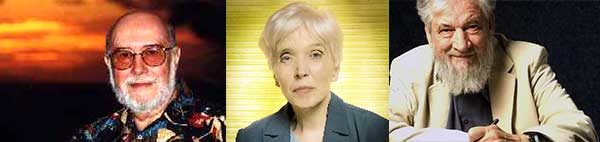
Oscar Ichazo, Helen Palmer and Claudio Naranjo
Oscar Ichazo, the Theosophical Society and channelled revelations
Meanwhile, returning to the twentieth century, Oscar Ichazo, studying in his library, also found evidence of the symbol in the teachings of certain Sufi schools and in the more recent Theosophical movement. By the age of 18, Ichazo had joined a group of Theosophists in Buenos Aires who discussed all kinds of esoteric issues, including Gurdjieff’s secret sources and the meaning of the Enneagram symbol. Ichazo soaked up all this information like a sponge and by his mid-twenties possessed a vast store of knowledge.
As a culmination, the placing of nine ego types on the Enneagram symbol seems to have come to Ichazo through personal revelation. In other words, he channelled it, attributing his illumination to a couple of disembodied entities: the Archangel Metatron, and a Sufi entity, the Green Qutub.
This sounds bizarre, if we envisage these entities to be blond-haired angels flapping their golden wings amid white puffy clouds. But to Ichazo, these were states of consciousness. Metatron represented a function of higher mind, which gave Ichazo the blueprint of his whole Arica system, while the Green Qutub personified surrender to divine will and receiving baraka, the energy of divine grace.
So far, so good. But, as is often the case with mystics, problems began for Ichazo when he started to teach his knowledge to others. As long as he confined himself to esoteric groups in South America, things went pretty well. But, in 1970, he invited a group of Americans from the Esalen Institute in Big Sur, California, to participate in a three-month training in the town of Arica, Chile. This, by the way, is how Oscar’s school got its name, because it began with the training in this obscure city.
Among those who answered the call was Claudio Naranjo, a Chilean-born psychiatrist who was living and working in the United States.
Enters Claudio Naranjo
Naranjo was bearded, brainy and hungry. He was no ordinary psychiatrist. He’d trained in Gestalt Therapy with Fritz Perls, dabbled in psychedelic drugs and was obsessed with contacting the elusive “Sarmoun Brotherhood” whom Gurdjieff said possessed great secrets of human transformation.
Astonished by the range of Ichazo’s knowledge, Naranjo was convinced the Bolivian knew the whereabouts of this mysterious Sufi school. But, alas, as far as we know, Naranjo never got the brotherhood’s postcode from Oscar.
After the training in Chile, Ichazo flew to New York and set up his new school in the middle of Manhattan. I still remember the address: 24 West 57th. We called it ‘GHQ’, short for ‘general headquarters’, the hub of a growing network of Arica branches that spread through the US and Europe.
Meanwhile, Naranjo had returned to Berkeley, California, where he began to develop psychological profiles of the nine ego fixation points. He also began to give lectures on the subject. Oscar Ichazo was not happy about this. He’d already criticised Naranjo on several occasions for being overly intellectual and was worried that his precious Enneagram would now be distorted. As it turned out, Naranjo’s eagerness to adopt the Enneagram as his own brainchild was nothing compared to the predatory instincts of the people who attended his lectures.
Helen Palmer, Bob Oakes, Almaas and Faisal
Among those present at Naranjo’s discourses were Helen Palmer, a Jesuit priest called Bob Oakes, Hameed Ali (who adopted the pen name A H Almaas) and Faisal Muqaddam. All of them would catch the Enneagram ball thrown to them by Naranjo and run with it, developing their own systems, writing their own books, offering their own trainings.
Later, Naranjo would complain to journalists that his precious ideas had been stolen by these people without giving him credit. How ironic! Naranjo, it seems, was incapable of seeing how he’d done exactly the same thing to Ichazo. Indeed, Naranjo even went so far as to claim that it was he, not Ichazo, who’d developed the psychological dimension of the Enneagram.
This is simply untrue. Back in 1974, when I was participating in a training at the Arica Institute in New York, we were given psychological profiles of all nine types as part of our instruction, coming directly from Ichazo. Certainly, Naranjo developed these profiles further, fleshing out the psychological aspects of each ego fixation, while Helen Palmer provided an even broader view of each type’s behaviour and attitudes. But the source of all this was unquestionably Ichazo himself.
For this reason, it seems to me that Oscar could have won the court case, if he’d been a bit more street savvy. But in some ways he was his own worst enemy. When asked by the court to describe his Enneagram theory, he replied, “It is not a theory. It is a fact.”
“Well, you can’t copyright a fact,” the court replied. Case dismissed.
New books on the market, by Naranjo, Helen Palmer, Don Riso
In reality, of course, it was a theory. But Ichazo was so insistent on asserting the objective reality of his precious system that he ended up shooting himself in the foot.
In 1990, Naranjo published a book about the Enneagram system, titled Ennea Type Structures, consisting of a dense labyrinth of psychological terms, mixed thickly with Christian theology. His book didn’t do well in the marketplace for the simple reason that few people could understand what he was talking about.
It was Helen Palmer, publishing around the same time, who blew the doors to the mainstream wide open and successfully introduced the Enneagram to the general public.
Meanwhile, a Jesuit student called Don Riso had beaten everyone in the race to the book stores. He’d read Bob Oakes’ notes from Naranjo and promptly wrote his own book, titled Personality Types: Using the Enneagram for Self-Discovery.
With these two books, penned by Palmer and Riso, the modern Bibles of the popularized Enneagram faith were born. Each step away from Ichazo had diluted the power of the system, making it tamer and more palatable, and when an amusing book, illustrated with cartoons, titled The Enneagram Made Easy was published by two of Palmer’s students, the social sanitization process was complete.
Meditation is beyond psychological, philosophical and spiritual concepts
Only a Disney movie about the nine types would now render it more cosily impotent. Which brings me back to that moment in the cafe, in Pune, in 1990, when someone handed me Helen Palmer’s book and suggested I should start teaching the Enneagram in the ashram. I had no problem with it. After all, I’d learned the system from Ichazo, so I had the original teaching in my hands. More importantly, I now had a much wider spiritual context in which to place it.
Osho was giving us a vision of spirituality that went beyond anything devised by Ichazo: a vision that began in meditation and ended in No Mind. In other words, one can study everything that Ichazo, Naranjo, Almaas, Faisal and Palmer have to offer in the way of psychological, philosophical and spiritual concepts, and still come up short.
Why? Because, as Osho explained many times in his discourses, the ultimate spiritual experience lies beyond anything the mind can conceive. It is beyond the realm of thinking. It is beyond the realm of self. It is an experience of silence, emptiness, infinite space.
Try writing a book about nothingness. Even the inventive creativity of those who have plagiarised Oscar Ichazo’s Enneagram system would have a hard time doing that. To me, the Enneagram is a handy tool for self-understanding and that’s why I continue to teach it. It has helped me get to know my personality and is a useful way of watching my mind, as it jumps through its usual hoops.
I can recommend it to anyone. But its deepest value lies within the context of meditation. That is the turning point, at which self-understanding becomes spiritual transformation.
Subhuti gives workshops about the Enneagram all over the world and also gives individual online Enneagram sessions. Contact: anandsubhuti (at) yahoo.com
More articles on the Enneagram, also by this author on Osho News
1/13/17
Case 5 of the Mumonkan
Mumon, Wu-men Hui-hai (無門慧開), the Chinese Ch’an Master says, "If you can respond to this dilemma properly, you give life to those who have been dead and kill those who have been alive."
Here is Case 5, "Hsiang-yen: Up Tree."
The priest Hsiang-yen said, "It is as though you were up in a tree, hanging from a branch with your teeth. Your hands and feet can't touch any branch. Someone appears beneath the tree and asks, `What is the meaning of Bodhidharma's coming from the West?'”
If you do not answer, you evade your responsibility. If you do answer, you lose your life. What do you do?"
______
It has been at least 6 years since I took up the case. I told another story about Hsiang-yen in a piece I wrote about a difficult and wonderful conversation that I had with my mother a few months before she died ("The Gift of Tears"). Hsiang-yen must have been an immensely gifted teacher if he continues to inspire others to be honest and human more than a thousand years after his death.
Today I find myself totally swept up in the hanging man's dilemma as I begin to re-work Step 1 of the 12 Steps. The Big Book of Alcoholics Anonymous puts the first step in simple, straightforward language: "I admit that I am powerless over [alcohol, drugs, food, sex]—that my life has become unmanageable." It's just the first step on a journey, and there is a story connected with my personal surrender.
Even if I'd never heard of Bodhidharma, there are questions in my life that I can't evade—my life depends on my answer. It might not be entirely clear to a 21st-century reader that the question about Bodhidharma coming to the West carries enormous weight for anyone practicing with a Zen master. My answer unlocks the wonder of practice and the Buddha Way.
At my first 12 Step meeting, when asked, "Are there other alcoholics/addicts present?" I automatically said, "Yes." I didn't grasp that the question was a life or death issue, that it carried all the weight of the person hanging by his or her teeth. I certainly didn't realize that it would turn my world upside down. I was about to learn that answering it truthfully meant that I was about to lose a life I'd become comfortable with, a life of deception I loved in a weird, perverted way. I'd learned to talk my way around my addiction so well that I even believed its lies.
I had been practicing meditation for decades, but I missed the immediacy and urgency in that question—right now, right here, people in this room were suffering real biological and psychological effects of drug and alcohol abuse. If I'd been paying closer attention, it might have been easier to see the delusions I'd have to give up, and admit that I'd lost control of my life, which is the baseline for any real conversation about sobriety. Another question follows an honest yes: could I examine the roots of my addiction clearly and move beyond denial? My sponsor was very direct: “Cut the bullshit and get real.” We all need real friends we can talk with, men and women who leave any pretense at the door.
Both the spirituality of the Big Book and Zen, I think, start from the same place: what in my experience got me stuck? It’s my dilemma, not the person on the cushion next to me, or the homeless guy stinking of urine on the bus that I can’t move away from. In Zen, I am never asked to believe anything outside my own experience, not even for a split second.
What transformed this question for me from an intellectual consideration about the nature of addiction and alcoholism to one with all the force of Bodhidharma's coming to the West and facing the wall for 9 years in meditation? My roommate committed suicide, and I found myself hanging from the branch by the skin of my teeth.
I came home to discover my roommate's bloated body had been dead for at least three days. Just the smell of the house was overwhelming. The shock sent me spinning emotionally and psychologically. The police and medical examiners suggested that I call a friend. The man I called came right over, put an arm around my shoulder, and listened without any judgment to whatever came out of my mouth as they carried Dean's body down the stairs.
My response was to lapse into an uncontrolled rage of using drugs and drinking. As I look back over those few days and weeks, Ash proved the depth of his friendship: he wouldn't allow me to play the victim, "Oh, you poor guy, how horrible!" or indulge any self-importance or fake heroism to let myself off the hook. He told me that even if I was just a guy who happened to be standing by when a tragedy unfolded, I still had to clean up the mess before I could move on. I had no other choice if I was going to choose life. He encouraged me to face the circumstances without drama and get it done. And he took me to a meeting. Friends don't get any better.
A long meditation practice follows me into the 12-step work, not as baggage but as a friend. When I listen to someone in one of the rooms coming to terms with the concept of a Higher Power, having been told that his or her program depends on acknowledgment and surrender to Something greater than the self, I can only admire the struggle and right-mindedness of their effort. My own experience was very similar. At some point, the practice of meditation, or maybe just growing older with more life experience, I dismantled most of the conceptual notions I had believed and put my trust in, but what replaced it was a far more intimate sense of how I am, at the core of my being, connected to the profound inner workings of the universe.
And even though my own inner experience started to become clear only after long hours on the meditation cushion, I know that this path is open to anyone, even in the blink of an eye. So meditate. Just do it.
The instructions to enter the koan’s world are really quite simple: Sit down, straighten out my spine so that I can stay awake and alert, focus on my breath, pay attention. That’s enough meditation instruction to get started. Then, as I settle in, if I choose, I can get real about how I respond to Hsiang-yen’s question, what do you do when you're hanging from a branch by your teeth? My life depends on my answer, where, really, no kidding, I'm going to fall into an abyss when I open my mouth. I don’t believe anything, not even for a split second, that I have not experienced myself, but I have also come to trust, thanks to my teachers and my own experience, that the koan will shake an honest answer loose.
Perhaps our answer allows us to simply fall into the unknown and follow the example of the trees' own leaves in the Fall. Thank you, Lucille Clifton, for the capping verse:
The Lesson Of The Falling Leaves
the leaves believe
such letting go is love
such love is faith
such faith is grace
such grace is god
i agree with the leaves
 |
| Sonja Fenne Margulies (March 7, 1931 - May 5, 2013) |