Search This Blog

Showing posts with label Goa. Show all posts

Wednesday, July 22, 2026

A saint for the East or the Portuguese expansion into the East?

Originally posted May 21st, 2010

After many years of Jesuit training, I took as a matter of faith that Francis Xavier was the first multi-cultural saint, having spent 11 of his 46 short years in the East. Nothing could be farther from the truth. His mission was closely tied to the Portuguese colonization of India, begun in 1498 by Vasco da Gama. Xavier arrived in Goa on May 6th 1542, along with Portuguese explorers, seamen, soldiers, and merchants—the first or second wave of occupiers. As a Jesuit, he vowed to spread the gospel of Jesus, but he was so fully aligned with European/Portuguese plans to dominate the East that it creates a very messy picture. Pope John Paul the Second, of Blessed Memory, was not around to hound Jesuits who delved into politics, though the army of God five hundred years ago was firmly in the pocket of the colonial, military-industrial, slave-trading complex. The exact opposite of Bob Drinan or Fernando Cardenal Martínez.


The history of any revolution or period of innovation is hard to read. I am skeptical of any authorized version, particularly a story of the human and divine interacting. Though the Roman church and the Jesuits insist that Jesus came to save all humankind regardless of race, or language, or tradition, when I look at the cultural artifacts of Xavier's mission, the architecture and iconography, I see a different story.


Portuguese governance of the territories they occupied in India lasted from 1505 through 1947. After Gandhi, these scattered coastal enclaves, known as Portuguese India, or Goa in popular parlance, began to be taken over by India. The pace accelerated in 1954, when peaceful Satyagrahis' attempts at forcing the Portuguese to leave were brutally suppressed.


This postcard commemorates the Saint issued by Portuguese India in 1946, a year before Indian independence.


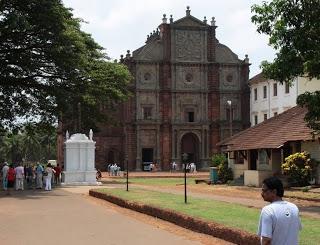
The following images are presented as evidence that Xavier was, and is still, a very European saint. The photographs are of Bom Jesu (1695 C.E.) and the Se Cathedral in Old Goa. (Photography by Garry Demarest.)


Xavier’s casket in the Basilica of Bom Jesu.


.

The nave of the Basilica of Bom Jesu


Close-up of the main altar in Bom Jesu


.

Another altar in Bom Jesu


Se Cathedral, Old Goa.


The nave of Se Cathedral.


Xavier is still part of the life of many Indian Christians, many generations removed from his appearance in Goa more than 450 years ago.

This is an older church in Old Goa that predates the current Basilica of 1695.


Roman Catholicism didn't completely conquer the hearts and minds of the local peoples. It is still India. Christianity can never be more than a competing cult.


The Creation of a European Saint in Baroque Art


Nicolas Poussin (1595-1664)

The Miracle of Saint Francis Xavier


Saint Francis Xavier by Andrea Pozo (1642-1709), lay brother of the Society of Jesus, 1701, Oil on canvas, Kiscelli Museum, Budapest.


Peter Paul Rubens 1617/1618


This monumental painting was displayed alternately with The Miracles of St. Ignatius of Loyola on the high altar of Antwerp's Jesuit Church.


St. Francis Xavier stands preaching to a crowd of people. Some of the miracles he performed as part of his missionary activity in Asia are vividly depicted, both as a testimony to the Counter-Reformation and as preparation for the beatification of St. Francis Xavier in 1619. A man is summoned back from the dead, the blind and lame are healed, and in the temple an idol is falling, broken, to the ground.


Depiction of one of the miracles of Francis Xavier.


André Reinoso, The Miracle of Saint Francis Xavier (1619)
at the Santa Casa de Misericórdia de Lisboa / Museu de São Roque, Lisbon, Portugal


Images from Japanese Art


Traditional screens. Images of the great Portuguese trading ships. Jesuits, or priests, are among the passengers.


And finally some of the sweeter images of Xavier. Although my analysis has portrayed Xavier as a very European figure, that is not to say that his influence was entirely negative. (The tonsure on Xavier might indicate that he has been incorrectly identified with one of the Franciscans who followed the Jesuits in Japan).


Wednesday, July 10, 2019

The Meanderings of Francis Xavier

May 22nd, 2010

For my friends Garry Demarest and Tom Marshall, travelers and seekers.

"Where to start is the problem, because nothing begins where it begins and nothing's over when it's over, and everything needs a preface: a postscript, a chart of simultaneous events. History is a construct....." Margaret Atwood, The Robber Bride


My friend Garry Demarest was in Goa a few weeks ago, and I suggested that he and his camera seek out the Basilica of Good Jesus, the final resting place of Francis Xavier. (I never imagined that I'd ever visit myself, but now I've been twice!)

April 7th was the 504th anniversary of Xavier’s birth, and though neither Garry nor I were aware of any celebrations, if he had arrived just a few weeks earlier, he could have seen the mummified body of the saint carried in procession from Bom Jesu to the Cathedral across the street for veneration.


Veneration was also part of my request: I was asking Garry to help me complete a spiritual journey by paying respects to Xavier with his fine eye and camera. My experience of spiritual journeys is that they contain precious few endings and many beginnings. In fact, the journey seems like countless beginnings with a common thread. But I had intended my request, and my desire to follow Xavier in much the same spirit as I understand Ignatius’s making his confession to a friend before the Battle of Pamplona, when no priest was at hand—the first step of his new life after soldiering.

I wanted to end my tracking of the meandering Xavier, but truthfully, I also wanted to be done with Xavier. His adventurous spirit was heroic—you have to admire that. He traveled to the edges of the known world over treacherous waters in vessels that were like leaky rowboats compared with what modern mariners sail, and reportedly, the man never acquired a sailor’s belly. On the other hand, he made me uncomfortable. His concern for all men and women, when that seemed fully present, was generous and loving, but, reading his own words, he seemed to trip over a rigid, dogmatic understanding of the world.

Saints are human beings, and, in my view, some of the men and women whose lives Christians are told to admire and imitate also possessed, or were possessed by, some habits of mind that make the world less bright and friendly. Xavier seemed dogmatic, judgmental, and stubborn, always ready to pick a fight. He was also reckless. If just his own life were in jeopardy, I might be able to attribute it to his quirky behavior. However, if you read carefully, he also put others in harm’s way. The ethos aboard a Portuguese man-of-war certainly encouraged bravado in the face of danger, but it seems to have fed a kind of fanaticism in him. And although he was a guest in Japan and didn’t know the language and customs, it is clear that he tried to stir up ill will towards Buddhist monks for what he perceived as sexual abuse of minors. His intention was to topple their authority and present the teaching of Jesus. I make no secret that I would favor that outcome in the current scandal of abuse that has rocked the church. Perhaps Xavier forces me to look into a mirror and see the vicious side of my own attitudes.


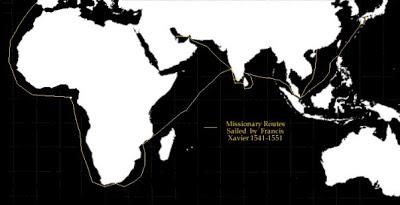
The reconstructed map of Xavier’s voyages looks like meandering, but they were certainly purpose-driven, as was he. Francis left Lisbon in 1541 and, for the next 11 years, traveled many thousands of miles, from Goa to Japan, with stops in Sri Lanka, Malacca, and the Moluccas. He established missions that were to be staffed by the many Jesuits who followed him. On December 2, 1552, two years after he left Japan, he died on the Island of Changchuen while waiting to gain entrance into the Celestial Empire. His body was dipped in quick lime and returned to Goa 15 months later.

In spite of my personal aversion to parts of Xavier’s personality, I still admire his courage and dedication. As a small tribute to his explorations, I’ve assembled the following images. I’ve supplemented Garry’s shots with others that I found on the Internet. My only criterion was that I found the images interesting or beautiful. Credits for the photos appear if they were available.


The Beginnings of my own Journey

I began reading about Xavier more than 8 years ago when Tom Marshall gave me the 4th volume of Schurhammer’s Francis Xavier: His Life, His Times. I had wanted to read Xavier’s letters to Ignatius from Japan, especially several in which he describes his meeting with the Zen adept “Ninxit,” his transliteration for Ninjitsu, the abbot of the Zen Temple, Kinryu-zan Fukushoji. This was the first encounter between Zen and Christianity. The year was 1549, and soon after Xavier landed at Kagoshima on Kyushu, the southernmost island of Japan.

I attempted to reconstruct the meeting between Xavier and Ninjitsu in Buddha S.J. There were some hints that he formed quite a wonderful friendship with Ninjitsu that was not entirely driven by his missionary zeal. Apparently, Xavier broke off his relationship when he could not convert Ninjitsu and pushed further north.


Xavier’s letters to Ignatius are the only record of this encounter. Xavier was writing to his friend and mentor, but he wrote with a kind of formality I didn’t expect, although my understanding of letter-writing conventions 440 years ago is entirely based on best guesses. Xavier may have taken a very dogmatic tone because intermediaries might read them, or they were what Rome and Portugal wanted to read, or they may have just reflected the rigid side of his personality. He also brought only the most rudimentary linguistic skills, and he seems in no way prepared for the kind of conversation he tried to have. He was aware of his handicap and, in his letters, recommended thorough linguistic training for the Jesuits who would follow him.

[Signature of St. Francis Xavier taken from a letter to King John III of Portugal, dated May 16, 1546. The letter itself is in the collection of the 26 Martyrs Museum, Nagasaki, Japan. Go to their catalog for further inspection. I have not reproduced the entire letter as requested. I am also conscious that the Museum may not be entirely comfortable with my portrayal of Xavier.]

The story with a larger series of images continues at A saint for the East or the Portuguese expansion into the East?


References:
Francis Xavier: His Life, His Times, Vol. 4: Japan and China, 1549-1552, Georg Schurhammer, Jesuit Historical Institute, 1973
St. Francis Xavier, J. M. Langlois-Berthelot, Jean-Marc Montguerre [pseud.] Trans. Ruth Murdoch, Doubleday, 1963.