Real Wars kill people. Mythological Wars create cults
23rd April 2022, the Feast of Saint GeorgeI'm going to write about Mr. Gurdjieff against the backdrop of the Russian invasion of Ukraine.
I cannot hide from real human suffering. If I really acknowledge how little I can do to change this situation, I know I'm powerless. Nonetheless, I constantly check online for the latest updates. I count the children evacuated from Mariupol. I wonder how many fighters remain in the labyrinth of bunkers and tunnels built to withstand a nuclear attack.
I know which side I should root for, or more accurately, I know which side I want to win, although I'm not aware of all the factors that govern my impulses. It seems clear that there are good guys and bad guys. I don’t know if Volodymyr Zelenskyy is hiding secret sins, but I can see Vladimir Putin in Russian TV news clips, keeping his distance at the end of a long white table with arcane golden imperial symbols planting its legs on the floor. His generals sit far away. Does anyone give him accurate information about the progress of his narcissistic war? It's a world of lies and manipulation. I have no reason to believe otherwise, though if I were in Russia, I would hear an entirely different story, and I know I would feel differently. What is accurate information, what is propaganda, and how can I tell the difference? Using filtered information is always tricky. I find sympathy impossible.
I am uneasy. My perceptions are almost archetypal, like watching Arjuna and Lord Krishna surveying the battlefield, going on and on about the “big picture.” I should direct my reflection back to the Bhagavad Gita when things are less heated, the actual winners and losers have been sorted out, and the bodies buried. All wars have consequences, but I am not in the horrific underground labyrinth of Mariupol. It is a theoretical conversation. I cannot know how or where we have been injured, even when I try to get personal about the cost.
However, this mythic, fable-like perspective is perfect for examining the story of George Ivanovich Gurdjieff.
The Stray Dog*
More than 100 years ago, during the Bolshevik Revolution, very close to this same battlefield, Gurdjieff started his wandering that would eventually take him and his followers to France. He had tried, unsuccessfully, to establish his Institute for the Harmonious Development of Man in Tbilisi, then soon after in Essentuki. By 1920, he and his followers left Georgia for Constantinople. He'd become a stray dog, forced into roaming by the progenitors of the army currently bombing, slaughtering, and raping.This small group of men and women was drawn from the Russian elite. Eventually, they found their way to Le Prieuré in Fontainebleau-Avon. This French chateau, the residence of Louis XIV's secret wife, Madame de Maintenon, was abandoned after a previous revolution impoverished its aristocratic owner. Then the first major global conflict created a mammoth fixer-upper where these homeless exiles set up an esoteric school.
They remained an elite group for the next 29 years he taught. Some prominent figures came to study with Gurdjieff, but he authorized very few senior students as teachers and left us scant, for the most part, very difficult, poorly written materials. Yet he has an outsized impact on modern spirituality. Many proponents of the Western Enneagram cite Gurdjieff as the source of their psychological/spiritual tool, though their claims are far from certain.
Gurdjieff was vague about his teachers. In Meetings with Remarkable Men, and in several other places, he makes them the stuff of legend, idealized characters, almost caricatures in a mythic story of discovery and intrigue. They imparted a special, hidden teaching. They are never clearly identified. This is the very nature of esotericism—obscure and only understood by a small number of people with special (and perhaps secret) knowledge. Understanding these teachings requires an initiation.
I meet “The Work.”
I moved to Berkeley in 1973 and began work in Claudio Naranjo’s Seekers After Truth, a name he borrowed from Gurdjieff. Our group of 50 to 60 people came from all walks of life. There were psychologists and professors, a Jesuit priest and a Franciscan Friar, two seminarians, one former nun, a devotee of Swami Rudrananda, a rabbi’s wife, and one woman who’d been associated with the Gurdjieff Foundation; several Ph.D.’s, two medical doctors, school teachers, at least one lawyer, more than a handful of psychology graduate students, body workers, therapists, a film-maker, a martial artist, a C-level New York fashion executive, Ravi Shankar’s mother-in-law, one professional journalist and a film distributor; but there were also carpenters, house painters and a French hippie. We were mostly white, straight (only 2 or 3 gay people), a large proportion of Jews, one Muslim, and a few Asians.We explored the Enneagram of Fixations, and, by extension, told ourselves we were engaging in “The Work.” The figure of G.I. Gurdjieff, always referred to as “Mr. Gurdjieff,” or "Mr. G.," his pronouncements, statements about the nature of the universe, humankind’s ultimate purpose, and his methods for spiritual work were treated as sacrosanct. Beelzebub's Tales was spoken of in hushed tones, but rarely read. If you read it but didn’t understand his jibberish or the insidious properties of the mysterious organ Kundabuffer, you were advised to re-board the spaceship Karnak and delve more deeply into the mysteries that eluded you. This language purported to have roots in several esoteric Eastern spiritual disciplines. Using it, wrestling with the complexity of the inner states it purported to describe, was part of the process of introspection, which Gurdjieff described as “Self-Remembering.”
Gurdjieff’s teaching has been passed down to us in several distinct categories. The carefully written unreadable book, Beelzebub’s Tales to His Grandson: An Objectively Impartial Criticism of the Life of Man; Meetings with Remarkable Men, apparently combines his own autobiographical work with a draft by his student, A.R. Orage, and finally Life is Real Only Then, When “I Am,” are fragments of talks edited by one of his principle students, Jeanne de Salzmann. The writing of students that Gurdjieff authorized, most notably P.D. Ouspensky's In Search of the Miraculous, also received his imprimatur.
There are anecdotal memoirs of students, plus extensive transcripts of his talks. The writings of men and women (both genders are represented, but men far outnumber women) who stand in the lineage of Fourth Way teachers who purport to transmit Gurdjieff’s teaching and to claim authority to teach. Finally, there are extensive writings by people who describe their own experiences and interpretations of his teachings. These vary widely from memoir to metaphysical speculation to hagiography.
I use the word “myth” to denote stories told about Gurdjieff’s understanding of the complexity of our human nature, driven by some overriding knowledge of the ultimate purpose of our human predicament. They include the repetition of phrases or instructions to people who sought his direction as they undertook their own inner search. Though Gurdjieff was a real person who had real contacts with humans that were, from their reports, immensely transformative, the myths that I am talking about are, for the most part, second-generation, embellished stories that share more with Aeneas’s journey from Troy than, and (I chose my example carefully) Krishnamurti’s talks at Ojai. Though I love Virgil’s poetry, I prize Jiddu Krishnamurti’s analysis.
I was born five years before Gurdjieff died in Paris, 29 October 1949. I met and had several conversations with one person, Lord John Pentland, who knew Gurdjieff over a long period and had been his student as well as a person he authorized to teach. I also knew several of Pentland’s students, most intimately a fellow Jesuit and gay man, Father Tom Charbeneau. I met the writer, Pamela Travers, who was Gurdjieff’s student, and I had a long association with Kathy Speeth, who sat on Gurdjieff’s knee when she was a toddler. I worked intensively for several years with Henry Korman, who claimed to be in the lineage of Fourth Way teachers, but later confessed to being a fraud. Others, most importantly Claudio Naranjo, used selected phrases and stories about Gurdjieff in their own teaching. Although I have combined this experience with my wide reading, I state at the outset that I am not a student of the Fourth Way, nor do I claim to have conducted a comprehensive study of Gurdjieff’s Teaching.
Gurdjieff’s public portrait is complex and tightly edited by his followers. On top of that, each one does his or her own editing. I have tried to report as accurately as possible what I can surmise from my own reading and research, as well as what I’ve been able to glean from second-hand accounts. For the purposes of argument, I've set my narrative against an idealized version of the man I’ve pieced together. Naranjo did not present himself as an heir to Gurdjieff’s teaching, but he was certainly conversant with it and frequently cited Gurdjieff as a prototypical teacher of the inner work he favored. He labeled him a “trickster,” standing in a venerable line of teachers who use unorthodox, even unethical means to compel a student to learn something they can’t see for themselves. Naranjo talked about “The School,” an interrelated set of teachings and teachers whose work could be traced, using some psychic map, to the same Source.
This unfettered style often veers outside normal ethical norms and opens the possibility for abuse. The end justifies the means. Our newfound sexual freedom encouraged an attitude of laissez-faire, which inevitably led to exploitation. Naranjo was very interested in psychedelics—he encouraged experimentation with drugs, notably LSD and Ayahuasca; he and his leaders allowed interactions that were outside professional guidelines; teachers’ credentials went unchecked or were inflated. In post-hippie, Beatnik California, Naranjo was not alone, encouraging some of these behaviors, engaging in some, and turning a blind eye to others. Many New Age teachers shared this sin. It comes part and parcel with the top-down authority structure that framed the conversation.
Trying to be as transparent as I can be in this conversation, I have spent an inordinate amount of time in my adult life exploring New Age esoteric and occult, a highly suspect endeavor, populated with the likes of Mme Helena Petrovna Blavatsky, Edgar Cayce, Charles Webster Leadbeater, or Aleister Crowley. They all purported to be authentic or enlightened teachers with a clear channel to “All that Is.” This is rocky terrain, rife with snake oil salesmen and outright frauds. Some of these people were more convincing than others, basically because they spun better yarns, but the frauds all seem to have this in common—their stock in trade was taking advantage of vulnerable people. In my case, it was a severe personal crisis that I didn’t even recognize. I was looking for a way out. By directing my attention to my plight, seeming to dismantle it and returning life to some level of normalcy, acceptance, and happiness, roped me into its intrigue.
Several friends have discouraged my investigation. One asserts that Naranjo is not as important as he was when we were part of SAT, that his influence is waning. Another warns that negative comments deter people from undertaking the difficult work of introspection. These cautions do not deter me. The influence of Gurdjieff in modern, non-religious practice is far wider than might appear at first glance. It warrants examination. It extends from the presentation of the Enneagram in a Catholic setting to several “Human Potential Trainings/Processes,” notably the processes directly connected to the Fischer-Hoffman Process of Psychic Therapy, which Naranjo promoted and introduced to SAT.
Most importantly, “The Work '' struck a chord with me, opening up a world that I had to explore. I got caught in the trap of not being able to see my own plight clearly. When I could open my eyes, I was forced to admit that I’d been the fool. It was a very uncomfortable predicament. The amount of personal capital that I’d already invested obscured the situation. What makes this gnostic enterprise difficult to crack is that it begins to unmask both the entrapment and the self-deception, the very thing that I’d sought to free myself from in the first place. It provided some sense of relief, but a half-right answer is still wrong. Freeing one hand provided relief, but I was still a slave.
Gurdjieff’s public portrait is complex and tightly edited by his followers. On top of that, each one does his or her own editing. I have tried to report as accurately as possible what I can surmise from my own reading and research, as well as what I’ve been able to glean from second-hand accounts. For the purposes of argument, I've set my narrative against an idealized version of the man I’ve pieced together. Naranjo did not present himself as an heir to Gurdjieff’s teaching, but he was certainly conversant with it and frequently cited Gurdjieff as a prototypical teacher of the inner work he favored. He labeled him a “trickster,” standing in a venerable line of teachers who use unorthodox, even unethical means to compel a student to learn something they can’t see for themselves. Naranjo talked about “The School,” an interrelated set of teachings and teachers whose work could be traced, using some psychic map, to the same Source.
This unfettered style often veers outside normal ethical norms and opens the possibility for abuse. The end justifies the means. Our newfound sexual freedom encouraged an attitude of laissez-faire, which inevitably led to exploitation. Naranjo was very interested in psychedelics—he encouraged experimentation with drugs, notably LSD and Ayahuasca; he and his leaders allowed interactions that were outside professional guidelines; teachers’ credentials went unchecked or were inflated. In post-hippie, Beatnik California, Naranjo was not alone, encouraging some of these behaviors, engaging in some, and turning a blind eye to others. Many New Age teachers shared this sin. It comes part and parcel with the top-down authority structure that framed the conversation.
Trying to be as transparent as I can be in this conversation, I have spent an inordinate amount of time in my adult life exploring New Age esoteric and occult, a highly suspect endeavor, populated with the likes of Mme Helena Petrovna Blavatsky, Edgar Cayce, Charles Webster Leadbeater, or Aleister Crowley. They all purported to be authentic or enlightened teachers with a clear channel to “All that Is.” This is rocky terrain, rife with snake oil salesmen and outright frauds. Some of these people were more convincing than others, basically because they spun better yarns, but the frauds all seem to have this in common—their stock in trade was taking advantage of vulnerable people. In my case, it was a severe personal crisis that I didn’t even recognize. I was looking for a way out. By directing my attention to my plight, seeming to dismantle it and returning life to some level of normalcy, acceptance, and happiness, roped me into its intrigue.
Several friends have discouraged my investigation. One asserts that Naranjo is not as important as he was when we were part of SAT, that his influence is waning. Another warns that negative comments deter people from undertaking the difficult work of introspection. These cautions do not deter me. The influence of Gurdjieff in modern, non-religious practice is far wider than might appear at first glance. It warrants examination. It extends from the presentation of the Enneagram in a Catholic setting to several “Human Potential Trainings/Processes,” notably the processes directly connected to the Fischer-Hoffman Process of Psychic Therapy, which Naranjo promoted and introduced to SAT.
Most importantly, “The Work '' struck a chord with me, opening up a world that I had to explore. I got caught in the trap of not being able to see my own plight clearly. When I could open my eyes, I was forced to admit that I’d been the fool. It was a very uncomfortable predicament. The amount of personal capital that I’d already invested obscured the situation. What makes this gnostic enterprise difficult to crack is that it begins to unmask both the entrapment and the self-deception, the very thing that I’d sought to free myself from in the first place. It provided some sense of relief, but a half-right answer is still wrong. Freeing one hand provided relief, but I was still a slave.
The logical fallacy of the Argument from Authority.
Let's examine the logical fallacy that brings down the whole house of cards. Gurdjieff argues that man has the possibility of being awake, but to wake up, he or she must set an alarm, a conscious mechanism he or she inserts into his unconscious routine to remind him that it's a dream. But there’s a catch: once the alarm clock has been set and has worked a few times, the mechanisms of our human mind grow numb to its sound, and it doesn't work. We fall back into sleep. The human perpetual sleeping machine needs a perpetual waking machine, one that stands outside the habitual way of being. Thus, we need an awake man (sometimes a woman, but rarely), a guru who knows, vs. an ordinary asleep man just going through the rituals of survival and coping. To top off the esoteric mechanism, when you realize that you are asleep, you need to find and pay this awake person to wake you up.*The argument from authority is “[a] formal fallacy in which it is argued that because a perceived authority figure (or figures) believes a proposition (relevant to their authority) to be true, that proposition must therefore be true. This is also known as an appeal to authority. This fallacy occurs when person Y claims that person X is experienced in the topic at hand. Therefore, whatever person X believes is the truth. Alternatively, this can also occur if person Y claims to be the authority, therefore whatever person Y believes is true. This fallacy is a special case of the generic fallacy where the source is used to justify the acceptance of a conclusion.”
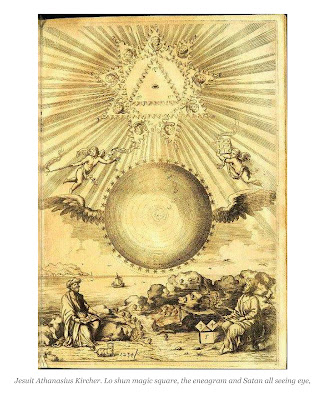
Who stands in the position of X at the top of the enterprise of the Western Enneagram as the person of authority? When describing the origins of the Enneagram, we find oblique references to Gurdjieff. The main candidates for any authorized source swing between the truly secret teaching of Gurdjieff or his followers, to Arica founder Oscar Ichazo and his student Naranjo, with some dubious stops in the Sarmoung or Naqshbandi brotherhood, or (this one is close to my heart) in the work of a 17th-century Jesuit polymath, Athanasius Kircher.
I argue that all these stories are fishy—to use a technical term. Most conversations about spiritual life are crippled by weak arguments. The impulse to expand the world beyond what we can perceive and verify is not the exclusive property of Gurdjieff's metaphysical construct. The awake person knows something that you do not know, something your present condition blinds you from seeing, but something that can alter your present condition by correct analysis. I argue that this argument from authority is consistent across all revealed religions: for example, the dogmatic claim that the Pope, by virtue of his authority alone, can issue statements that are “infallibly true” despite any factual evidence. I will also point to the passion for miracles, physical occurrences that stand outside the normal laws of cause and effect. I use the word “passion'' purposefully because even if we can’t personally witness these extraordinary events, we “believe” them, assuring ourselves in the benevolence of the unseen world, guiding us when we lack clarity, and for the purposes of this argument, providing authority as we grapple with the unknown.
The proponents of what I call the Western Enneagram Teaching as a tool for self-observation point to the appearance of the nine-pointed mandala in Gurdjieff’s teaching, plus a few other references, found mostly in the works of Ouspensky and Bennett. But in Gurdjieff, the Enneagram outlines the steps for the movements, or sacred dancing, combined with a rather complex set of laws of three and octaves—certainly nothing that points to 27 categories of personality fixations, virtues, or holy work.
The first person in the Americas, and the first person to refer to an Enneagon, was the Bolivian esotericist Oscar Ichazo. In 1968, Ichazo presented lectures on his theories of Protoanalysis at the Institute of Applied Psychology in Santiago, Chile. It was there that Naranjo made contact with Ichazo. Later at Ichazo’s first training in Arica, Chile, Naranjo began his own investigation of what he termed the Enneagram of Fixations.
Naranjo wove a convoluted tale of Sufi masters disguising their teaching and tricking their disciples, and wove it into his story about receiving the Enneagram from Ichazo. My skeptic tells me he was just trying to establish an authorized teaching lineage by characterizing his difficult relationship with Ichazo as a Sufi trick. To further break with the pesky facts, Naranjo describes his understanding of the Enneagram as the result of automatic writing. Appealing to an otherworldly realm for evidence, one of Ichazo’s disciples says that an esoteric volume fell from a shelf in Ichazo’s study, opened up to the Enneagon diagram, and Ichazo divined its gnostic meaning.
I want to point out that all these conversations themselves are privileged. They rely on the status of the speaker rather than hard evidence to prove the validity of the Enneagram/Enneagon. Both the claims and statements fall entirely within the argument from authority to confirm the system’s validity.
You don’t believe me? Then why are we still having this argument about the correct or authorized source? Q.E.D.
The proponents of what I call the Western Enneagram Teaching as a tool for self-observation point to the appearance of the nine-pointed mandala in Gurdjieff’s teaching, plus a few other references, found mostly in the works of Ouspensky and Bennett. But in Gurdjieff, the Enneagram outlines the steps for the movements, or sacred dancing, combined with a rather complex set of laws of three and octaves—certainly nothing that points to 27 categories of personality fixations, virtues, or holy work.
The first person in the Americas, and the first person to refer to an Enneagon, was the Bolivian esotericist Oscar Ichazo. In 1968, Ichazo presented lectures on his theories of Protoanalysis at the Institute of Applied Psychology in Santiago, Chile. It was there that Naranjo made contact with Ichazo. Later at Ichazo’s first training in Arica, Chile, Naranjo began his own investigation of what he termed the Enneagram of Fixations.
Naranjo wove a convoluted tale of Sufi masters disguising their teaching and tricking their disciples, and wove it into his story about receiving the Enneagram from Ichazo. My skeptic tells me he was just trying to establish an authorized teaching lineage by characterizing his difficult relationship with Ichazo as a Sufi trick. To further break with the pesky facts, Naranjo describes his understanding of the Enneagram as the result of automatic writing. Appealing to an otherworldly realm for evidence, one of Ichazo’s disciples says that an esoteric volume fell from a shelf in Ichazo’s study, opened up to the Enneagon diagram, and Ichazo divined its gnostic meaning.
I want to point out that all these conversations themselves are privileged. They rely on the status of the speaker rather than hard evidence to prove the validity of the Enneagram/Enneagon. Both the claims and statements fall entirely within the argument from authority to confirm the system’s validity.
You don’t believe me? Then why are we still having this argument about the correct or authorized source? Q.E.D.
Debunking some myths around “Mr. Gurdjieff” and “The Work.”
Before I begin to debunk any mythological constructs. I will note what first attracted me to "The Work,” what I found useful, where I opened myself to abuse, and finally, how I began to become disenchanted. Throughout, I will be paying close attention to language. Zen posits that what's important to discuss is beyond words, but we have to use words; they may be an approximation, but they are the only tool available to humans. Some esoteric language points to important issues in life, while other language—I will use a less technical, but very precise, word to describe this abuse—is gibberish.When I was 29 years old, after just a few months working with Naranjo, I had an experience that lifted a huge weight that I’d been carrying for many years. Sitting in that ramshackle fraternity house in Berkeley, it struck like lightning. Its debris would take years to sweep up. I uncovered the motivation for my decision to train as a Jesuit, a dream that began in adolescence. Unpacking it, dealing with the consequences, including the abuse that played out, would be a long, slow, and costly process, but it opened a new vista for my life that I could not have imagined. I remain grateful, but in retrospect, the experience was so overwhelming that I was blinded to its limitations.
These were heady days. Naranjo told us that he was setting up a school that would be a smorgasbord of available spiritual disciplines, shorthand for “Esalen Style.” Experimentation was the norm, and, given the circumstances, the path might prove rocky, even dangerous. I knew that I needed psychological help, but I also wanted to avoid professional treatment. As a Jesuit, therapy was not out of bounds, but still carried enormous baggage if I wanted to advance in the Order. The prospect of blending spirituality with the insights of psychology provided cover. For any psychological process to work, however, it requires a level of vulnerability, but in the freewheeling world of SAT, time-tested ethical and professional principles have been suspended. There were casualties, and personally, I ran up against very difficult obstacles. Being raped by an uneducated tailor who claimed to be the psychic channel for a dead psychiatrist certainly fits in that category.
Naranjo, much like Gurdjieff in Meetings with Remarkable Men, told tales of receiving information from other sources. Bob Hoffman told him things about his past that Hoffman could not have possibly known, or that was Naranjo’s claim,* and therefore the whole group would be subjected to the Fisher-Hoffman Process of Psychic Therapy, despite Hoffman’s obvious lack of professionalism. On the other hand, the discipline of Fritz Perls was far from unprofessional, and when Naranjo sat in that chair, he was the consummate professional. People in SAT relied on Helen Palmer’s costly psychic readings as prognosticators of behavior patterns, things to work on. Some people used their alleged connections to the other side as sources for psychological investigation. There was Anne Armstrong (who gave me unsolicited and disastrous advice about a business deal) and a specious Chilean palm reader to whom Kathy Speeth is indebted for losing her license to practice therapy in California.
I made a list and named names, far from complete, to point out the otherworldly, suspect sources of many of the psychological techniques used to probe the roots of personal psychological makeup. Key to any of this having therapeutic benefits is surrender. Suspension of judgment opens the back door to the unexpected, revelatory, hidden motivations, the dark family secret that has been lurking and putting up barriers. However, investigation shifts from analysis of counterproductive behaviors to tracing their source, as if dream analysis á la Oracle at Delphi had become a substitute for free association, and the mind-altering experience of LSD a quick route to the fruits of meditation practice.
But what if this type of inquiry does not stand the test of time or produce real results? Spiritual charlatans have a huge bag of tricks—they act like drugs—to induce experiences of ecstasy and revelation. I was told over and over to “suspend [my] judgment, enter into another state where things will be revealed.” This is an exact quote; some version of this is repeated ad nauseam to this day. To be honest, sometimes sleight of hand is useful in discovering a personal blind spot, but at some point, if the trick is not revealed for what it is, it becomes part of the illusion.
We know that some mental processes work below the surface. They are unconscious; if they remain hidden, they wield enormous influence, and we remain in their thrall. But a simple dream about having a heart attack is no predictor. Casual or surface exploration serves little purpose other than to induce fear. When a friend told me about having a dream like this, I asked if he’d seen a cardiologist. But I also knew that I suspended my judgment many times when it would have been better to allow my actually well-trained critical faculty to maintain the upper hand.
Hoffman once told me that his dreams had predicted that he would be cured of cancer because he had a higher calling, and I believed him until I took care of him when he was dying of cancer. I’d been doing professional hospice work for nearly a decade, so I was not particularly shocked by his lack of acceptance of his own death. He was in complete denial, expecting another psychic miracle and very angry when it didn’t appear. I have detailed some of the unraveling of his pretense and absurd lies behind his psychic understanding of life in other writings. Perhaps I ought to listen to my mother and not speak ill of the dead. I have to confess that I was far too close to the man to be objective. His sexual abuse was always in the background, but he never made amends—he was far too arrogant to admit any faults. But there was also something more interesting going on, the beginnings of the erosion of the framework underpinning his system and, by extension, the entire work that Naranjo undertook with his groups.
In response to a friend's request to examine particular Gurdjieff sources, I came across some talks in which he made very definitive statements about the differing roles of women and men. These were the urtexts, transcriptions of his talks to students either at Le Prieuré or in his Paris flat. It seemed all very high-tone, even provocative, but it had the confrontational tone of a bully. Part of my mind revolted, and I realized that it was simply outright misogyny, delivered in an extremely arrogant tone, quite similar to what I experienced in the men whom I’d met who claimed their authority by referencing the Armenian seer.
There was no abrupt “Ah ha” moment. In my mind, I'd constructed a protective shield for this figure who was held in utmost reverence by people I respected. He was, we were told, a man who knew himself. I told myself that the misogyny had to be a function of time, place, and circumstance; this charismatic member of an elite group who’d undertaken a heroic exploration of ancient traditions and helped find a key to some of life's mysteries, and provided a key, or what I imagined was a key, to self-understanding.
But what if Gurdjieff himself was an ordinary man ruled by circumstance? Being a man lulled to sleep by life’s circumstances was exactly what “The Work'' sets out to conquer. This sleep keeps us enslaved. What about all the rest of what Gurdjieff claimed? The house of cards began to fall. I gave up surrendering to a set of ideas that produced a modicum of results. They were based almost exclusively on the word of a man who claimed authority by his experience and hard-won understanding of man’s plight. It stood or fell on his authority, real or imagined. I could no longer stake my life on this teaching.
The argument from authority is “[a] formal fallacy in which it is argued that because a perceived authority figure (or figures) believes a proposition (relevant to their authority) to be true, that proposition must therefore be true.” But what this authority figure proposed was blatantly false. What Hoffman claimed about the psychic workings of the mind was absurd. Naranjo's claim about the origin of the Enneagram of fixations was at best a hallucination. Gurdjieff was a bully, a sexist, and a misogynist. Believe them at your own peril. Q.E.D.
I do not, however, want to throw out the whole barrel as if it were filled with rotten fish that stinks to high heaven. I remembered the words of Pyotr Demianovich Ouspenskii, whom Gurdjieff thought was a convivial partner to share a glass of vodka with at The Stray Dog, but “a weak man”. If Self-Remembering can get us here, even for an instant, it was worth all the effort.
“…that you can know consciousness only in yourself. Observe that I say you can know, for you can know it only when you have it.”
And I emphasize this sentence: “And when you have not got it, you can know that you have not got it, not at that very moment, but afterwards.”
After a period of time and reflection. It took a while.
____________________
*The Stray Dog. A Saint Petersburg cafe where Gurdjieff held forth, according to G. Lachman. It is the presumed site that elicited the comment from Gurdjieff that Ouspenskyy was a personable guy to drink vodka with, but a weak man.
* When I first heard of wokeism, this is what my mind conjured up, and the term does insist on a degree of blanket “correctness,” including its underlying assumptions.
Ichazo has said that “in order to understand the originality of the perspective of the Arica Integral Teachings, it is important to remember that Buddhism is based on the epistemological and immediate discovery or knowledge of the world as being fundamentally in a state of suffering (Skt. samsara). This is the First Noble Truth. What the Arica Theory proposes is an ontological foundation with the discovery that one step behind suffering, we find the actual root of that suffering, and this step behind discovers, answers, and defines the ontological proposition that there must be a being, an Ego–entity, that supports that suffering.” The Roots of Buddhism and Arica Integralism
Bibliography
Claudio Naranjo
End of Patriarchy: And the Dawning of a Tri-Une Society, Paperback – 1 Jan. 1994
Cf. Chapter on the Fisher-Hoffman Process of Psychic Therapy

