Search This Blog

Showing posts with label Pedro Arrupe. Show all posts

Tuesday, July 7, 2026

Nanquan Cuts the Cat, Part 2

Book of Serenity, Case 9; Gateless Barrier, Case 14; Blue Cliff Record, Cases 63 & 64

May 13th, 2026.

  
 2. Obfuscation and Silence


When I entered the Jesuits in 1966, the Second Vatican Council had just ended. The Catholic world was experiencing the exuberance of John the 23rd’s throwing the windows open. A General Congregation of the Jesuits had just elected a Basque priest, Father Pedro Arrupe, as our new Father General. He was charismatic. We younger Jesuits felt he could lead the largest and most educated religious order in the post-Council era. He’d been less than 10 kilometers from the epicenter of the Atomic blast in Hiroshima, a horrific event that weighed heavily on my generation of Americans, including most of the men who entered the Jesuits with me.


Arrupe’s predecessor, Father Jean-Baptiste Janssens, had been elected two years after the defeat of the Nazis. We’d heard his reputation as a strict disciplinarian. We also knew that he’d worked with the clandestine Benedyk Grynpas network during the occupation of Belgium, but for some reason, that was rarely acknowledged. He forged baptismal certificates for Jewish children, but never required that they be baptized. He taught them to say the Hail Mary but only so they could pass a Nazi interrogation if caught. He hid a large group of Jewish children in his own residence. He quietly encouraged other Jesuit houses, monasteries, and convents across Belgium to hide Jews. He undoubtedly knew the 43 Jesuits who died in the camps and the more than 100 other priests who were murdered resisting the Nazi regime. He’d been their superior. He knew that if he were caught by the Gestapo, he would be executed, but he did the right thing.  He was honored with the title of Righteous Among the Nations by the Knesset of the new State of Israel in 1954.


I didn’t have to go back to 15th-century England to find examples of heroic men of conscience. Most of my superiors, teachers, mentors, and spiritual guides had been trained by this very courageous man. Many had worked with him directly, but he never wore his resistance like a badge. If he ever spoke about it, we never heard it. The job of piecing together the Jesuit order after the war, coupled with managing the largest influx of “vocations” in the order's 500-year history, was enormous, equal to responding to the plight of Jews during the Holocaust. It was another task of matching actions with words and sacred promises, but without the real threat of execution 


The stain of antisemitism in the Catholic church is extremely troubling; the record of the institutional Church during the Third Reich has become the topic of a heated debate. There is one group that claims that Pope Pius XII did his duty and maintained absolute neutrality, but to others, he appears cowardly, even sympathetic towards the aims of national socialism. The role of Father Włodzimierz Ledóchowski, the head of the Jesuits during the war, is equally mixed. He certainly saw reports about the extent of the mass murders. Claims that the Nazis were skillful at hiding their atrocity feel like an excuse. Both Pacelli (Pius XII) and Ledóchowski have been described as “benignly” antisemitic. Many old noble European families were. It was part of an ancient class stratification that Americans don’t understand. How could priests, bishops, and popes keep silent unless they were hedging their bets, or even being sympathetic to the Nazis?

After months of wrestling with a vague, undefined flight between Nanquan’s monks of the eastern and western halls, it was no longer speculative. A question whose answer determined life or death was right in my face; it was a question that cut so deeply there was only silence, or an answer whose horrific consequences were impossible to escape.

In my mind, I convened a Board of Examiners—three professed senior priests—to interview the monks of the western and eastern halls—a typical Jesuit tactic. I asked if the English Reformation had been a power grab among 16th-century monarchies, was the Jesuit mission doomed from its conception. Was the sacrifice of the English martyrs even justified? When I extended that hypothesis into the ambiguity of the Catholic response to Hitler, I was told that I was being revisionist in my reading of history. It reeked of the same equivocation that Father Garnet was accused ot. I couldn’t recall the sainthood of the English Jesuit martyrs, though opposing the cause of Eugenio Pacelli might be justified depending on a more careful review of the history. The hard fact that both the Jesuits and the College of Cardinals, right after the War, elected men, Janssens and Roncalli, who were named Righteous Among the Nations, tells me that they wanted to land on the right side of history.


However, my questions missed the point of the koan. I wasn’t being asked to speculate: if a group of Jewish kids showed up at my door, and I knew that helping them would put me in the same grave danger they faced, would I rise to the moment? Right now is not five centuries ago.


The tone is correct. It didn’t have the urgency and the immediacy required, but at least I had managed to put breath and blood into the argument between the eastern and western halls, one that carried the weight of life and death. The koan ends with Zhaozhou taking off his shoes and putting them on his head. We are told, in a scholarly tone, that this was an expression of grief in ancient China. 


Could I go through a painful experience of dealing with questions about my entire religious life and end with a funeral joke? I’d caught a few laughing Zen students take off their shoes and prance around, with no sense of how profoundly their world has been turned upside down. But there it was, a note about an ancient Chinese funeral ritual in the marginalia, handed down through at least a dozen roshis, and brought into the dokusan room where we dealt with the question. 


I’ve never seen convincing evidence to support the ancient Chinese funeral rite story. I searched Google. Did this practice, display, or joke exist in China during any dynasty? I did find some customs that stretch Western norms. In Taiwan, the bereaved family hires strippers and pole dancers if the obsequies go beyond three days. The motivation is not otherworldly. If the attendees are entertained, they don’t go home, and the priests maintain their minyan, or quorum, for the ceremonies. But we were being asked to believe that it was normal for Chinese mourners to dance with their shoes on their heads. This is at least suspect. 


There is a more straightforward answer: Up is down. Down is up. 

___________


References:

Rebellion of the Righteous: Jesuit Partisanship for Jews. In: Journal of Jesuit Studies, James Bernauer S.J.

Hitler's Pope: The Secret History of Pius XII, John Cornwell

The Jesuits and the Third Reich,  Vincent A. Lapomarda.


The American Jesuits, Schroth, Raymond A. Published by NYU Press 

The American Jesuits: A History. NYU Press, 2007. Project MUSE.


I’ve written three sections that will appear separately. Here’s the first. https://jesuskoan.blogspot.com/2026/07/nanquan-cuts-cat.html

Tuesday, September 5, 2023

August 6th, 1945, Carrying the Flame

This is a continuation of my earlier post about the movie Oppenheimer.

On July 31st of 1995, I drove with Maylie Scott from Berkeley over to Mayumi Oda’s house in Stinson Beach, just below Green Gulch Farm. I remember the day because it is the Feast of Saint Ignatius, and my friend Ty Cashman was living with Mayumi at the time. Ty was a friend who, like me, had been a Jesuit. Then we were both practicing Zen Buddhists.

The purpose of the visit was to receive a small flame that Mayumi had carried from the fire that burns at the Peace Memorial in Hiroshima, remembering the more than 140,000 innocent men, women, and children indiscriminately murdered on August 6th, 1945. There’s an eternal flame in the memorial park commemorating the 15 kiloton bomb that burned at 4000 degrees Celsius at its center. Mayumi had kindled a candle there and somehow secreted it aboard her plane back to the US. My job in the passenger seat of Maylie’s small car was to guard that flame on the bumpy and twisty road back to Berkeley. From there it would be carried to light the candles for a ceremony that would begin the blockade of the Livermore Lab. Maylie had organized the protest with the Buddhist Peace Fellowship to commemorate the 50th anniversary. She and several others would be arrested and spend several days in jail.

I mention the Jesuits because one of the main reasons that a number of Jesuits have become dedicated Zen Buddhist practitioners is the leadership and inspiration of Father Hugo Makibi Enomiya-Lassalle, and Father LaSalle was in Hiroshima on August 6th, 1945. He was walking on a hill above the city, about 6 or 8 kilometers from the epicenter and was injured although I have no clear information about the nature and extent of his wounds. Another very important Jesuit Pedro Arrupe was also close to the epicenter, leading a class for the Japanese Jesuit novices. The windows and doors of the building were blown out, but I couldn’t find any record of reported injury other than radiation poisoning, and I don’t know the extent. Arrupe went on to be elected as the General of the Society after the Second Vatican Council, and was the General during my years as a Jesuit. LaSalle became a student of Harada Daiun Sogaku Roshi, and after Harada’s death, he continued to work with the lay master Yamada Koun Zenshin Roshi, a relationship that lasted for the rest of his long life. There have been more than 10 Catholic religious who have been authorized as Zen teachers who came to the practice through LaSalle. That is an amazing accomplishment. I could say that all three of these men, Arrupe, LaSalle, and Yamada have had a profound personal impact on my life though I never met them. And so did the dropping of the bomb. I was just 1 year and 72 days old. I have lived under the shadow of annihilation for 78 years along with the rest of humankind.

A woman friend thought that the most appropriate response to the bombing might be retreat to a cave or dark church. In fact LaSalle created a zendo for the Jesuits and other religious who sat with him. It is still beside a flowing mountain stream above Tokyo and he named it Akigawa Shinmei Cave. There is an appropriate time for the silent grieving along with an inner search. Arrupe and his novices immediately sprang into action, went down into the streets of Hiroshima and began to look after the wounded and dying as best they could. I don’t know what my response would have been. I do know that when Maylie went to jail, it was a work day for me and I could not join the protest. Besides, someone had to make sure that Maylie’s aging mother was taken care of whilst her daughter was being arrested.

When my friend David Weinstein was sitting with Yamada in Kamakura, he remembers seeing Father LaSalle coming from Dokusan often in the early morning. One day he was standing with Yamada Roshi and they waved goodbye to LaSalle. Yamada turned to David, and said, “there is the man who is always teaching me how to apply the koans to life.”

Father LaSalle is buried in Hiroshima in other "hibakusha," survivors of the immediate conflagration. They are the front line in our fight to ban these weapons, and why it was so important for Maylie to carry that flame from Hiroshima to the Livermore blockade 50 years later..

Monday, January 2, 2023

“Don’t speak ill of the dead.”

My mother said that many times. It might be an old Irish warning before they broke out the whiskey at the wake.

OK, but I am not going to join the chorus of praise for the pope emeritus either. And it has begun in full force. I will bet money that the cause for his canonization has already been written and is a foregone conclusion. He was probably not the pernicious conservative rat that the neo-libs want to portray, but he was no angel. He loved his cats, so not all bad, but he was a little too gay for most conservatives. There might be a fight between cat lovers and opponents of those crazy red pumps. 


I just listened to an interview with the neo-conservative George Weigel. He talks about the bromance between John Paul 2 and Ratzinger. According to Weigel, this is the heart of their argument: “The Council had really been the work of the holy spirit, but its implementation had been less than satisfactory because it had not been properly understood. It was not seen in the context of the church’s settled tradition.” So they set out to give the Council an authoritative interpretation. Their contention was that the Council was not a paradigm shift; it was not starting the catholic church over again. 


This is my view. When the fathers in charge surveyed the work of Vatican 2, and realized that it spelled the end of the monarchy that their power and livelihood depended on, they began the process of limiting the damage. Paul 6 was the harbinger. Still in the thrall of John 23, he was neither a visionary nor a strong man; either would have been a disqualifier for the enclave that elected him. John Paul 1 may or may not have unleashed a hornet's nest by starting an audit of the finances of the Holy See, and he didn’t live long enough to even really begin the work. However the scare was enough to propel the unlikely, and extremely conservative Wojtyła to almost 3 decades of fomenting and leading a backlash, hounding Arrupe and all the liberal Jesuits who were involved in social action and, god forbid, liberation theology, the list goes on, but he had an amazing team of supporters, Subito Santo. He anointed the man who just died to continue the work of “reinterpreting” Vatican 2. 


I was elated when Ratzinger resigned. He lived on and had a nice retirement. But my gut feeling is that he became a kind of Silenced Saint. Support for an all-powerful papal monarchy has become more entrenched, and perhaps even increased. Look at how tired and worn out Francis looks after 10 years.


How much support could we gather for a “Get back to Jesus” movement in the Roman church? Well, at least Ratzinger is no longer available to write a compelling list of reasons against it while pretending that it’s already in place.


The word for the day is “bowdlerize,” as in he was great if we can just cut out the offensive parts, or why in hell didn’t he consult the damage control consultants beforehand? Here are some of my favorite bits from the life of Ratzinger et al:


Regarding the rehabilitation of neo-Nazi Bishop Richard Williamson of the Society of Pius X  by lifting his excommunication. https://truthspinners.blogspot.com/2009/02/problem-with-benedict.html


And moving right along, his pandering to sex abusers mixed in with his nifty red slippers, https://truthspinners.blogspot.com/2021/07/no-sackcloth-and-ashes-for-these-guys.html


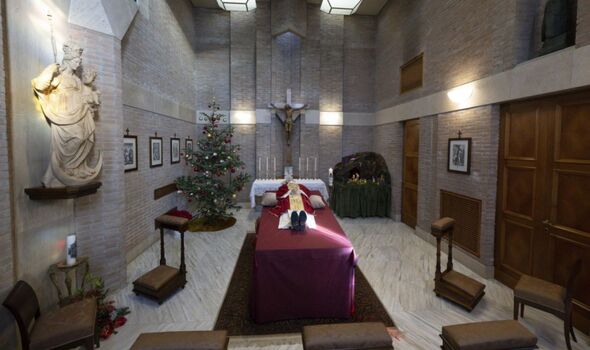
pope benedict xvi lying in state

Francis is not going to win the cold hearts of the neo-con's with this less than regal pic.