Search This Blog

Monday, August 19, 2024

Raksha Bandhan


Tradition bids me tie a ribbon on your wrist 

To say that you and I are related,

And it will always be

No matter what

What husband, what wife, 

what daughter, what son,

What lover, what friend,

May kisses, caresses

Abound.

May wounds be few.

No matter,

There will be love.


What prizes and honors won, 

Include the ones you lost,

What joy, what laughter, 

what grief, what loss,

What trouble, what pain, 

what fear, what tear, what discovery, 

Embrace it freely.

In this moment

You are my world.


We are blood and yet so different

It makes no difference

What barrier, what fence

What wall, what boundary.

Cross, venture, explore,

A postcard now and then might be nice.

Calls are also cheap these days,

But neither is required.

I know there are only so many 

Seconds, minutes, years granted to us.

Use them as best you can.

As best we can.

I will try.


Make mistakes,

I will join you.

We are forgiven in advance.

You are encouraged to make as many as possible 

Unharmed or even injured.

Try to stay safe.

Continue please. 

You encourage me.


Forgive me if I have hurt you.

It was not intentional.

I know that I can be blind and careless.

You are also forgiven.


The world as we find it

Is a blessing.

You are part of my world.

Sounds trite

But it’s true.


Raksha Bandhan 2023


Thursday, August 15, 2024

Reflections on the Feast of the Assumption

Mary, Mother of Jesus, Mother of God, pray for me, a sinner.


The traditional vow days in the Jesuits are feasts of the Virgin Mary, today, August 15th, and September 8th, her birthday. I took my simple religious vows on September 8th, 1968. It was common for most young Jesuits to take Mary as their “vow" name. So I might have said, “I, Kenneth Maria Ireland, vow to your divine Majesty, before the most holy Virgin Mary and the entire heavenly court, perpetual chastity, poverty, and obedience in the Society of Jesus.” I asked to keep my given name, and it was granted. 


As far as my Marian faith goes, I am a pretty stripped-down, basic gospel kind of guy. Some of this can be traced back to my Calvinist heritage; my father was a Yankee free thinker, and there was some rebellion against the rigid Irish nuns who taught the Baltimore Catechism by rote. I have zero desire to make a pilgrimage to Fatima or Lourdes. Apparitions are far too spooky for my rational mindset. I’ve always held that Mary's “Dormition” is far more palatable than her bodily transportation to the Gates of Heaven. I prefer myth when it comes to such matters. The infallible pronouncement of Pius 12 happened when I was 8 years old; even then, I wondered how something this momentous could be hidden and unrecognized for such a long period of time. I said the rosary every day when I was in a Jesuit house of formation. We all did. I liked the repetition of the words of a simple prayer and the contemplation of the mysteries I took to be more like visualizations of scenes from the stories told in Matthew, Mark, and Luke (John is a bit too gnostic). 


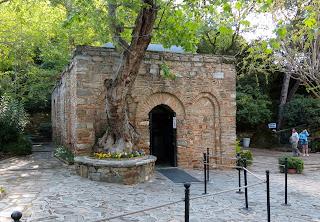
By Erik Cleves Kristensen - House of the Virgin Mary


When Ashish and I visited Ephesus, after tromping through the amazing Roman ruins, we took a small jitney several kilometers high up into the bluffs overlooking the ancient harbor to what is known as Mother Mary’s House. According to legend, Saint John, the gnostic one, took Mary to the small community that Paul had founded in that Roman colony after the death of Jesus. She was to spend the rest of her days protected from the turmoil of James’s Jerusalem Church. Of course, her presence also legitimized the ascent of the Jesus congregations of Greeks and Romans who were not observant of Jewish law and customs, but I will leave that side for polemicists to hash out.


When I got on that small, rickety bus, it had been more than 35 years since I left the Jesuits and 30 years of practicing Buddhist meditation. I’m just giving some background about the mindset of the guy who headed up Mt. Koressos (Turkish: Bülbüldağı, "Mount Nightingale") to the place that Saint Anne Catherine Emmerich had seen in visions as Mary the Virgin's last earthly abode.


It fit the parameters of a place that I could envision for the house of Mother Mary. Being there was wonderful and peaceful, with a genuine feeling of the Transcendent. No throngs of the faithful seeking miracles, no massive basilicas commemorating a Saint’s vision, no sellers of Marian trinkets and memorabilia. There were perhaps a dozen religious women, maybe less, quietly tending simple gardens and very austere shrines. We wandered wherever we wanted and stopped when we felt the urge. No one exhorted us, telling us what to believe or how to pray. There were few votary candle boxes like the ones I remember from the Irish parishes of my youth in front of Saint Mary’s statues. There was only one donation box near the exit.


I felt a real sense of freedom when I boarded that rickety little bus for the scary ride back down to Selçuk. I had been in the presence of the Virgin, and my mind was allowed the space to take whatever tack was appropriate for the time and place.


Friday, August 9, 2024

Eucharistic Flop, a lifeless, bloodless sacrilege

Why the Eucharistic Congress was not just a costly, meaningless show but a sacrilege: many of my ex-Jesuit friends fault it for being an anachronistic diversion from the nuts and bolts, tedious work of Tikkun, repairing our torn and frayed world with poverty, migrants, homeless people, misfits, fundamentalist racists, children murdered in Gaza and Ukraine, conscripted soldiers slaughtered, terrorists assassinated by high tech missiles that can find your bedroom window. The list seems endless. Worse for the activists is the fact that it seemed to be orchestrated by an increasingly right-wing leadership in the American Church as a counterpunch for what they see as the activist agenda of the liberal Jesuit Pope. 

All those cogent reasons are, well, very cogent and appropriately political. What better way to shore up the memory of our forgotten religious life, where the priest was god's representative, and we faithful cowered in pews on the designated night and sang “Tantum ergo Sacramentum,” not having a clue that Thomas wrote those words after he had the experience of seeing all the hundreds of thousand words of very cogent theology disappear like so much straw and less idea of what any of it meant. I loved singing genitori genitoque, especially when we got to procedenti ab utroque, meaning that any meaning came from somewhere else, and I had no idea where, although that was a bad translation. But in general, now that my Latin is better than before a Jesuit education, I find the whole affair poorly conceived from somewhere else.


I was saddened by the silly parades, with thousands of altar boys in black and white, priests in white and gold, and bishops in lots of gold and big hats, stumbling along with no sense of what a religious procession might look like. They might have been trying to be regal and dignified, but actually, the volunteer fire department does a better job marching behind their red trucks on the 4th of July than these school boys could muster behind the crudely decorated trailers that were being dragged by the best trucks that the diocese could borrow from the Knight of Columbus who had a concrete company. Firefighters have a purpose. A New Orleans funeral marching band has a purpose. These jokers were doing something that they had been ordered to do. That seemed to be their only purpose.


The problem for me, however, goes beyond the aesthetics of mounting a religious festival with the obvious political agenda of lending support to an anachronistic, monarchial church of yesteryear. It is in the trivialization and even commercialization of God’s Presence. If I can be bold, even Thomas missed this. We are not worshipping a thing, a piece of flat, tasteless bread that has been magically changed by uttering magic words. When I bow before the Great Sacrament, I bow to the Presence of God. It is present, it is immediate, it is transformative. Instead of a flat, lifeless speck of white carbohydrate, it is love, intimacy, and mystery. All that got lost, not just lost in the sense that there was a piece missing and we knew that something was missing. It was lost in the sense that the ceremony didn’t even point to that Great Presence that is with us but invisible to our ordinary senses. Maybe Thomas, you did get it--Sensuum defectui..


And how much money did this farce cost?


Monday, August 5, 2024

"The Three Key B’s of Buddhism: Bowing, Boring and Bliss," by Phil Whalen & Ken Ireland


Phil with Allen Ginsberg and Anne Waldman at Naropa

Bowing, Boring, and Bliss


I recall a talk about “Bowing” by Zenshin Phil Whalen at the Hartford Street Zen Center. Damn, I loved his talks. He was, without a doubt, one of the most literate men ever to don the robes of a Zen priest anywhere, at any time. And if you want to challenge me, I’ll be suiting up on the Dalai Lama’s debate ground up here in McLeod Ganj. 


But first things firstI was going to try to record the talk, but I was my usual bumbling self with electronic equipment, and I couldn’t get the machine working in good time. Being his usual patient self, he yelled at me, saying that we didn’t have all day and, anyway, some things were just not meant to be recorded. Sometimes, words are purposefully impermanent. It was not like he was going to recite some goddamn hidden, secret sutra for the last time before he croaked.


So I lost the talk, but I am going to do my best to reconstruct it from the basic “B’s” as I remember them.


He began by saying that if he really wanted to write a bestseller, his publisher would insist that he come up with a title like the “The 10 Recondite Rules for Clean Buddhist Living” or something like that. So let’s give it a try: “The Three Key B’s of Buddhism, Bowing Boredom and Bliss.”  Perhaps Phil’s publisher was onto something. More than 20 years have passed, and I still remember long sections of his talk (it’s also true that, as with many teachers, he returned again and again to his favorite topics, like an old horse headed back to the barn).


When he was in Japan, in the monasteries and temples there, everyone bowed three times. People just always bowed three times. But for those who couldn’t count, he said, before he just sat down to begin his talk, he bowed nine times. We all bow nine times at Zen Center; why is that? Well, he said, when the first students gathered around Suzuki Roshi in San Francisco, they went to him one day and complained, “Roshi, we love you, but we’re Americans, and we don’t like all this bowing. We don’t understand it. So why are we doing it?” And the Roshi said with a smile, “Oh, so you don't like bowing three times? Good. Perfect. I think we should bow nine times. Better that way, More practice.”


So we bow nine times. Better that way. Practice.


Phil then told an anecdotal story about some legendary old Japanese teacher way out in the middle-of-nowhere backcountry who was revered for the callous on his forehead. He explained himself: one of his first teachers had scolded him for being stubborn and told him bowing would be a good practice. So he began bowing. He never stopped. He discovered that the body is stubborn and the mind is stubborn. He said that he would stop when he stopped being stubborn. So he just kept bowing and thus the calloused forehead. In one way or another, we’re all like that.


Then he said that Zen students actually have it very easy. In Tibet, all the new monks bow 100,000 times before they do anything. It’s called Ngondro, and it involves the whole body, not just your forehead, hands, arms, knees and feet touching the floor but your whole body flat out, like you were a swimming fish, and it’s so strenuous that it takes a lot of effort to reel back and bounce back up. Do that a hundred thousand times. I’m told that it’s a purifying exercise. But it’s not done with some idea of repentance like Christian pilgrims bowing every three feet along the Camino de Santiago. It’s done because we practice meditation with every bit of ourselves wholeheartedly, fully, without reservation, holding nothing back. 


And then he said that anyone who’s lived in Asia knows that bowing is just good manners. It’s a sign of respect. You tilt your body down, your eyes are not focused on the face of the person you’re greeting, and your whole body is lower. Of course, you’re going to bow lower to a king or abbot. There’s a whole book of bowing etiquette: you bow very slightly to someone who’s your equal, but your bow is lower when you greet your parent or someone who’s older out of respect. That’s why we bow to our teachers in a formal situation. We’re showing respect and love. And we show it by using our whole body and mind. Our mind bows down, and for maybe an instant, we’re slightly less arrogant. We have to throw every bit of being into the bow.


But the most important thing, and here is a place where I actually have Phil’s own words, from his notebooks from Tassajara, we have to make it our own. In the rule-infested monastery or practice center, we ask ourselves, are we “bowing to rules rather than using them? We must contrive to be Buddhas & patriarchs rather than students who are good at following schedules (and bowing).”


But you’ll notice, he said, we follow a certain order in the zendowe bow to the cushion, then everyone else in the room, and we sit. How strange, bowing to the cushion. We’re not bowing to a Buddha or a person. You can think of it any way you want to. Sometimes, I like to think that I am bowing to the practice, but that is really way too abstract. Sometimes, I do it just automatically, without thinking much of anything. But in any case, we just do it. What you think about is probably not important.


Now we get to the B for boring.


We sit, and almost immediately after, we learn to sit with only slight discomfort. Our bodies become both more relaxed and more alert, and we get bored. We all have our own experiences, but I’ll tell the world I get bored.


But then the mind, it’s like fiddling with a bungled up ball of twine, if you try to untangle it when you’re frustrated or angry, the knots are just going to get tighter. You’ll be looking for a knife (He laughed). I’ve pictured the mind as a bag of worms or a net of living anchovies. But you get the point; it’s a conundrum, it’s a mess. It may be filled with ghosts or paranoia or algebraic equations. It doesn’t matter. Whatever it is, it’s just there, all tangled up. 


So there’s this big mess of thread sitting in your mind, and you just begin to play with it without much purpose, no rhyme or reason. You tug a bit here and notice that’s a bit looser over there, but you’re relaxed, and maybe you follow the thread to a knot that looks tight, but on closer inspection, it loosens up and falls away. And maybe after a while, there’s just a whole mess of lovely threads in front of you, and though you really don’t fully grasp how it happened, there it is.


Then the bell rings. 


I’ll end by quoting Mr. Robert Bly, who tells us to follow our bliss. Of course, Mr. Joseph Campbell has also told us to follow our bliss, and he did it on the Public Television Station, so it must be something worth doing. But I was watching Bly talk about it on the TV and found him quite interesting, if not persuasivebecause bliss is not something I can buy, like the gummy bears I get at Walgreens. It’s just there. 


Some very fussy Buddhists might describe it as a fruit of meditation. If you hang out long enough, it’s just there because it’s always been there, but you wake up, or you open your eyes, or you open your heart. I’ll agree that it’s just there, and it really doesn’t matter how it got there. But this is something it shares with gummy bears: when you taste it, you know that it’s a gummy bear.


Sometimes, it might feel like something is lost in the process. Bly quoted a poem by Antonio Machado, which I quite like.

The wind one brilliant day called to my soul with an odor of jasmine.

The wind said, “In return for the odor of my jasmine, I’d like all the odor of your roses. ”

[Machado said,] “I have no roses; all the flowers in my garden are dead … ”

The wind said, “Then, I’ll take the withered petals, and the yellow leaves, ”

and the wind left. And I wept. And I said to myself, “What have you done with the garden that was entrusted to you?”

I think that’s enough for today. Keep bowing. Thank you.


Monday, July 29, 2024

Thank you, Stan

Stanley Robert Stefancic, age 86, passed away on Friday, June 28, 2024.

My deepest condolences to Marianne, Benjamin and Sandy, their children, and all Stan's family and admirers.


On June 15th, Stan wrote to me on Facebook: “Hi Ken, I’m sorry I can’t answer in more detail! But I want you to know that our relationship means a lot to me, Love Stan.” I knew about his grave diagnosis and suspected that this might be a short goodbye from a very dear friend. I wrote back as quickly as I could.


Dear Stan,

Circumstances have planted me on the other side of the world, which is a disadvantage when it comes to sitting with you, old friend, being quiet when appropriate, or chatty when the cat smiles. It’s what I would love most right now, but here I am in Bangkok, so this is the chatty part. This might be a long note, probably longer than necessary, but I hope it's not burdensome. My mind is racing over the years that we have known one another, flashing on the high points, our connection, the shared stuff, and the just plain weird. For some reason, we’ve had quite a bit of that.


I read your last short note and wanted to respond, but not in a way that demanded a response. There is nothing between us that needs to be said. I have nothing but love and admiration for you. We’ve shared more laughter and wonder than most humans can imagine. Thank you for that. 


I remember sharing lunch with you in San Anselmo almost daily over several years. It was not a lifetime of lunches like cranky old men, but enough to verge on that subset. I remember one or two of our haunts. I remember what you ordered, or imagine I do. We had our Thai place; I particularly liked the small cafe above the creek where you could hear water rushing down after the rain and the ice had melted. Now I sit in Bangkok. The monsoon is just beginning. I listen to the sound of rain; I want to sit with you, hang out, and feel your presence. I wish I could share it with you. It does all come down to wonder. Just wonder. 


It was a hair-brained idiot who brought us together. I have to thank him for something; you were always more hopeful than I was that something good might come from his work. For me, those days at the Institute were like being in a Light and Love prison where everybody knew the boss was a lunatic, but bills needed to be paid. Do you remember when he put that bust of himself in the entrance hall of his tacky house in the Oakland Hills and then complained that it didn’t make him look cute enough? That should have blown the lid off all the pretentious hogwash, but I was captive and, I guess, suffering a bit of Stockholm Syndrome. Many of our lunch conversations were about dealing with that insanity and its side effects. I passed through the car wash and emerged a living, breathing human. You did well. Again, thank you. What a gift. 


There you were on one side of the table, having finished a degree at Harvard Divinity, had churches and responsibilities, but as you told me, maybe preached about Jesus once or twice. There I was on the other side, having dropped out of two divinity schools with no degree, less belief, and no responsibility but wrestling with the shadow of Jesus. Jesuit egghead and Unitarian bricklayer, what a perfect pair. 


I might even have to admit to believing in karma when I learned that I used to go the race track with the father of your son’s wife, Sandy and that I’d met her when she was maybe six in Bennie and Betty’s house on 12th Avenue. That still blows me away. I even won the trifecta once following Bennie's advice, but I was never good with money. Maybe karma plays a role, or I’m just thick but sometimes lucky.


Stan, my friend, you are the Rock of Gibraltar. I mean solid, really solid. I can’t count the number of times I started to go off on some half-assed Quixotic tangent, and you'd caution me. “Remember, there’s a lot of Claudio in that” or another cogent reason to move more carefully. 


Our worlds are less bright and exciting without you. I will try to keep your memory alive. I am so grateful to count you among my friends. I do love you.


Friday, July 19, 2024

Issan’s Jesus Koan


Memories in a shoe box

23 April 2010


This story is really about the moment I realized what I always knew—that even my own meditation doesn't belong to me.


The line from the dedication in the Soto Zen service at a temple founder’s altar, “May the Teaching of this school go on forever,” is almost a cliché. Are there even answers to the obvious questions, “What is the Teaching of this school?” “How, or even why, should they go on forever?” The founder’s teaching is treated like an assumption. I knew Issan as a friend, a man dying of AIDS, a hilarious prankster even when he was in great pain, and a teacher who opened up a vast, new exploration for me. Of course, I harbor assumptions, and if I were to examine his life as if he were the token gay Buddhist saint in drag, that might be more of a blinder than an opening.


A student from New York Zen Center’s Contemplative Care Program contacted me about unearthing information about Issan’s legacy. He had been referred by Rev. Rusty Smith, the Executive Director of Maitri Hospice, or as it’s now called, “Maitri Compassionate Care.” Since the separation of Hartford Street Zen Center and the Hospice, I feared that a lot of material had been lost. Adding to the predicament, Issan loved the phone, but the written word was not so much: there were no notes from the dharma talks. There were a few snapshots from Del Carlson, a close friend, one dharma talk that had been transcribed, and, of course, David Schneider’s wonderful “Street Zen.” As for the rest, the kind of stuff that you don’t really know what to do with, the sentimental gifts stored in an old shoe box, personal memories of the way that he interacted with each of us as his students, his jokes, the outrageous stories that you might not want to share with your mother—and there were plenty of those, where could we begin to look?


In early Spring of 2010, I ran into Bruce Boone, a longtime student of Issan, outside the Café Flore, which is only a short walk from the Hartford Street Zen Center. After the usual “bring me up to date” conversation, which, sadly, included news of his longtime partner’s death, we began to talk about our friend. 


I try to be on the lookout for any expression of his teaching that feels genuine and not anecdotal gay-feel-good Buddhism. I turned the conversation to gathering Issan’s old students together and beginning to record our memories of how our friend really taught us. I cannot remember if Bruce thought the gathering was a good idea, but he shared a story that moved me.


One morning in North Beach, he’d walked into a quiet church, the shrine of Francis d'Assisi, with his teacher, a gay man who had HIV and knew that he faced an inevitable painful death. Bruce might have been trying to offer Issan a place of rest, or maybe peace and comfort, or he might have been acting as a kind tour guide to the hidden shrines of San Francisco.


When Issan saw the image of Jesus crucified, he turned to Bruce and said, “Oh, that’s me.” Bruce, a former seminarian, said it brought tears to his eyes, but as he told the story, Issan spoke in almost an off-handed way. His tone was flat, and Bruce knew the remark was entirely serious. He called it “Issan’s Jesus koan.”


I knew that Issan had been raised as a Roman Catholic in the traditional Irish-American way, and as a young adult, he’d left the rank and file of practicing Catholics. I think that “reject” would be too strong a word. “Neglect” might be better, as in “hardly enough time” for the more pressing things in his life, running a commune, cleaning house, finding the perfect dress with the right hairstyle and make-up, and eventually drugs. But I had no idea how he held his inherited beliefs. Now facing pain and suffering, he was confronted with a familiar image from his impressionable years in a suburban catholic parish in Santa Barbara, and there it was—just recognition. It sounded almost matter-of-fact.


Bruce’s words kicked something loose in me—the cross as a koan? It had been almost 20 years since Issan died, and Bruce still held this story about Issan, one for which he had no ready answers or explanations in a loving way. Then he said, “Even those brief moments while I sat facing the wall when everything seemed clear as a bell, those few deep experiences have only begun to open up what he might have meant.”


Then I got it: Bruce has been sitting right next to me and meditating for me. He’d handed over the fruits of his zazen without a second thought. They were mine. How generous. Generosity is a necessary condition for sharing my meditation with the person sitting next to me, but I don't want my thinking too much to get in the way. It just happens. It is the path that the Zen ancestors have always used to transmit their experience to us. If it's a mystery or even a slippery slope, so what?


Hakuin Zenji’s hymn in praise of meditation contains the verse: “From dark path to dark path,” which seems an inescapable part of our human experience. But we can also sing “From bright path to bright path!” I’ve had moments when I saw clearly that the meditation experience is not a solipsistic self-generated enlightenment. I would be more than willing to congratulate myself for all the good effort that I have been making over many years in practice, but what if it weren’t necessarily so? What if the work has already been done or is always being done? Bruce has been working on Issan’s koan for more than 20 years, and all I did was stand next to him on the street for a few minutes. The Teaching of Issan's school has lived on for almost 30 years. Wrapping my mind around “forever” seems just a step away.


My friend Ken MacDonald added more lyricism to the Soto dedication at the closing of the founder's service:


"These teachings go on forever;

on and on they flow,

without beginning or end".


To read more reflections about Issan's life, see some photographs, and listen to a dharma talk, go to my page, The Record* of Issan.


Saturday, July 13, 2024

I met Frederick Copleston.

[Father Greg Sharkey visited me here in Bangkok last Monday. He lived with Copleston in the Jesuit house on Farm Street while earning his Sanskrit degree. I talked about this meeting. Greg also confirmed that the robe Father Copleston wore was the English Jesuit habit. I went to look for this short piece I wrote and tried looking for it on my blog. I am republishing it here].

In 1965, I met with the famous English Jesuit Frederick Copleston and could not come up with one decent philosophical question. 

I have been trying to collect the memories of our visit. It was 60 years ago, and not a huge breakthrough event in my spiritual journey, so parts of it are hazy and will remain so, but given that I was the only undergraduate on the schedule of a renowned Jesuit philosopher, it was an honor and, as you will see, memorable. Father Bill Nolan, the Dartmouth Newman Chaplin, of course, knew that I wanted to become a Jesuit and did everything he could to encourage me, which was the explicit reason for the interview.


The process of memory is notoriously unreliable. Recall activates a selective circuit in the brain, and we tend to recall those juicy bits that confirm the stories we tell ourselves. Even if the date, time, and location are reasonably accurate, even if they can be verified, the data collection system is not as if it were a selfie with the Pope. It still might be difficult to remember whether it was a bright day or if the autumn winds were blowing. On top of that, the things we retrieve may hold some key that we are not fully aware of. There could be some mystery-solving, like the crumbs you laid on the path to Grandma’s house. 


Copleston came to Dartmouth and stayed at the Newman Center for perhaps a week. I checked the online archives to identify events or colloquia in the Philosophy Department. None. Perhaps he had been scheduled at BC, Harvard or Fordham, and Nolan arranged to have him lecture at the Aquinas Center, which he often did. That is possible, even likely. It is also likely that if Copleston had been in Hanover at the invitation of the College, he would have stayed at Aquinas House. He was a very traditional old-school Jesuit who rose at 5 AM every day, did his meditation, and then said Mass. Mass would not have been complicated if the College put him up in a hotel room.


Bill Nolan gave him the office of his assistant for the week, and Copleston had office hours. I’m sure many Dartmouth faculty were anxious to meet him. I remember that my hour was carefully scheduled. I even remember what he wore. Over a simply tailored black suit and a tall white collar that I associated with Anglican clerics, he wore what I thought was a strange robe, even for a scholar priest. It was not the long black Jesuit habit I knew from the Jesuits at Fairfield. It might have been a don’s gown from Heythrop. There was no sash, and the sleeves seemed to be broad black ribbons that dropped from the elbow. I recall that his speech was very precise and soft-spoken. I would characterize it as meticulous. He didn’t rush, and my memory, even after 60 years, was that he was a careful listener. Google tells me he would have been just a few years older than my father, but I didn’t get any daddy vibe. 


He had just published Volume 7 of his monumental 11-volume History of Philosophy: Fichte to Nietzsche. His debates about the existence of God with Bertrand Russell, which made him very famous in Catholic circles, had taken place at least 15 years earlier, but I had no questions to ask about his writing or the debate. Perhaps Bill Nolan had told him that I wanted to enter the Jesuits, or I did. I told him about my parents' vehement opposition.


I was now 21 and could enter without their permission, and I was tempted to do that, but I promised them that I would finish college before I set off on what they considered a disastrous career choice. He asked me what I was studying and whether I liked it and pointed out how it would do no harm when I became a Jesuit. When he asked why I wanted to be a Jesuit. I mumbled something about being impressed by certain scholastics and priests in prep school. Then he got personal and told me that his own parents had opposed his becoming a Catholic priest, but he persisted and continued to treat them with love and respect. He said that they eventually came to support his decision. After some quiet time, he looked at his watch and said that he would have to begin preparing for another meeting and would pray for me. 


I had an interview with the man whom I imagined might have removed any doubt about Aquinas’s Unmoved Mover argument for the existence of God, and instead received the promise of prayer to resolve a painful family situation. 


Saturday, June 29, 2024

Fly Away, Koan 53, Blue Cliff Record

Case 53: Baizhang’s Wild Duck 


Great Master Ma and Baizhang were taking a walk when a wild duck flew by. 

“What is that?” asked the Master. 

 “A wild duck,” said Baizhang. 

 “Where did it go?” 

 “It flew away.“ The Master twisted Baizhang’s nose, and Baizhang cried out in pain. 

“Why, it didn’t fly away after all,“ said the Master. 


Wild Ducks


Why did it take a twinge of pain to wake me up?

The pain was real

Or at least I felt something

Asleep so comfortably, 

Mixed with dreams of geese (I transposed)

Flying away

Or landing

Or swimming in the reflecting pool in front of the Jefferson Memorial (I am dreaming)

They flew off course

Attracting crowds and iPhones clicking

As if to confirm Thomas’s 

Republican dreams.

.

Or did the somnambulist bump into a door

realizing the traffic just beyond

Might be real danger

Even being totally alert does not guarantee that I will survive


I feel as if sometimes I dance with your answers, Ma,

Was it a real question

Or just words, they are just words,

Sounds connected with a dream or twinge of pain


Master Ma talks as if there were a sequence of events

Let me correct him.

That has meaning.--flying, landing, then flying away

There is no causal sequence of events in dreams

They have no existence


Dream on.’

Listen to Keith Jarrett

He gets the dreaming sequence right

Mysteriously connected

Without pain.


Friday, June 28, 2024

Schism Schmisum--

On hearing that the Doctrine of the Faith summons former U.S. nuncio, Archbishop Carlo Maria Viganò, to testify on charges of schism. Vigano calls it an honor. I don’t know why you need to be so right, or maybe I just don’t understand it, but honey, you are just being a doctrinaire asshole.

Let’s talk schismatics or at least have a laugh or two.


Schism is defined as the formal separation of a Church into two Churches or the secession of some group (or an individual?) owing to doctrinal and other differences. Is this a threat?


I remember a conversation with Avery Dulles. As might be expected as the son of his famous father and a respected Catholic theologian, he served on several high-level ecumenical commissions. He told me (with his slight laugh and smile that disguised a complaint) that he often worked long hours on a paper describing doctrinal agreements and continuing points of dispute with a few modest suggestions to explore if the divide was real, imagined, or even important. And you can be sure his work was meticulous and exacting. The commission’s meeting began with a prayer petitioning the God of the doctrinal points they could agree upon and avoiding the rest. After Avery presented his paper, he was thanked and applauded. Then, the other side’s theologians presented a paper outlining their position and objections. They sat down and were politely applauded. Then they worked together on the closing statement: we can agree on X for Y reason, and we continue to disagree on Zed for Z. We were happy to have this exchange and pray for our continued growth in the Spirit, although let’s not go overboard in our expectations. Nothing changed and probably won’t--not after they appointed a woman as the presiding bishop, but let’s pass over that in silence and leak it to Kaiser or the NCR.


But all in all, this was far better than what might have happened just a few centuries earlier--one of those parties would have been burned at the stake. Depending on your side, the painful deaths of the heretics or martyrs became myths to warn succeeding generations, train them in self-sacrificial virtue, and remind them that some things can never be compromised. The Inquisitors made decisions about who needed to be celebrated, who needed to be blamed, and what lessons the survivors needed to draw. 


A bloody time. Thousands were executed. The Roman Catholics did it, as did the newly reformed English Church. The Spanish Inquisition is now the stuff of jokes, but it was a life and death matter for the Jews, the conversos, and the dissenters who were murdered. A lot has changed over a few centuries, but we can’t erase that part of history that affronts our sensibilities. Revisionists erase the parts of history that don’t conform to the current myth. But keep the threat of schism alive.


An earlier Jesuit cardinal was not so lucky. In 1599, immediately after he was appointed Cardinal, Pope Clement made Robert Bellarmine an Inquisitor, and he served as one of the judges at Giordano Bruno's trial and concurred in the decision to condemn Bruno to be burned at the stake. It was a hard, thankless task for the quiet, saintly scholar, but he had a job description. And there were schisms to the right, to the left, and particularly to the north. I mentioned that to Avery once, and he said thank God we’re past that (although he continued to make a case for capital punishment). And he made the very good point that at least we are talking to one another. 


Talking is a good thing. It's the only thing other than charitable actions and loving your mother. I say I would talk to anyone, but I really don’t think I want to be in the same room as Bishop Barron, Archbishop Carlo Maria Viganó, or Archbishop Sal Cordileone. Not that I couldn’t make small talk, but why bother? They would not be much interested in talking to me unless they might try to convert me, I suppose, and I think that the Compas are aware of just how open I would be to that conversation. Besides, my dance card is pretty full. 


I loved talking with Avery. Even though we were worlds apart on most issues, he and I always tried to find where we might have an interesting conversation. That changed slightly after he was made a Cardinal, but not much. 


The context was love, respect, and taking action to keep that flame burning. I told him that I went to confession with a high-church episcopal priest when I was doing my AA 4th Step because it felt right. He was a friend, and I was out of touch with any Jesuits I might have asked. He told me that although he disapproved, it was a valid sacrament. Then I had to tell him that this priest friend worked for the Jesuits at Saint Agnes in the Haight. Once, he was at a party for Bishop Ignatius Wang. The bishop got hammered and went on and on about same-sex marriage. My friend was wearing a clerical collar, and Bishop Wang probably presumed that my friend was Roman. His husband, sitting next to him, was wearing a sweater on the cold San Francisco evening. My friend didn’t introduce his husband for obvious reasons, such as job security. 


I almost got Avery to laugh.