Search This Blog

Wednesday, December 21, 2022

There was a death in the village

Yesterday was a difficult day in Jogiwara. I woke to cries of anguish when Hari’s mother discovered the lifeless body of her oldest son. The sun was barely up. Hari came into my house unannounced and told me that his brother had died in the night. I got up, put on some clothes, and went to the room where this lovely, friendly man’s body lay. His face had been covered with the blanket that had kept him warm during his last cold hours. 

People had already started to gather. There is no ritual book. Tradition takes over. It is all unspoken. People talk amongst themselves, but there are very few words spoken. No one has to tell anyone what to do. People know their roles exactly. The men and the women separate. The women gather around his mother and his wife. They fill one side of the room and sit quietly. Some of the women cry, but surprisingly, no one tries to comfort their mother. They just listen silently; they help her when she gets up. The young girls sit with the women. His nieces cry. At some point, Hari’s middle daughter tells me tearfully she doesn’t know what to do. She looks at me. I cannot help. Saying I am sorry is not enough, or it feels totally inadequate. 


There are almost no tears among the men. The young boys, the oldest of whom is his son, who is just 20, stay close to the men and help where they can, but they look a bit lost. Later at the cremation ground, his young son will be the only person dressed in ceremonial white to light the fire. I get the impression that this is one life lesson that has to be learnt by imitation. A few men sit with the body opposite the women. His uncles, both the Sikhs and Hindus, are joined by one Tibetan, a monk who lives in the village. He married, but still shaves his head. All the men are older than this young father. He was not yet 50. He had been sick. He had been in the hospital, but his death was still sudden. I try to read the hidden signs of grief, but I am lost. The women show much more emotion than we are comfortable with in the West. The men are far more restrained.


More men gather, but for the most part, stay outside the room. More arrive. I notice that some of them begin to disappear into the forest that abuts the house. A steady line begins to shuttle back and forth, carrying wood, large logs, and small brush. My guess is that a jeep has arrived on the road to carry the wood to the cremation ground. Each village has its own. I have been to three cremations during my time here. The first was an ex-pat Brit. It was traditional; the Indians took over; we, his western friends, stood and watched. Then my cook's mother died. We went to a gnat more distant from the village, down a long, steep path to the river.  


After about 3 hours, his body is carried from the room to a wide area outside the house. Some of the men begin to prepare it for burning. There are elements to add, flowers, seeds, and a yellow scarf. A more colorful blanket is spread over his body, and he is carried to another jeep on a pallet. If there are prayers I don’t hear or understand.


By the time I reach the cremation grounds, the bottom of the pyre has been stacked tightly with kindling underneath.. Only men are allowed; a large number are doing the work of carrying and preparing the logs. The pandit actually seems more like a work foreman than a priest. The fire must burn for at least 5 hours so that the ash is fine enough to be carried to the Ganges, 11 hours away. Suddenly, four or five women push in. They cry and shout. Again, I am startled by the indifference of the men. After a few minutes, the women are ushered out. Then his body, enclosed in a metal grate, is moved onto the huge stack of wood that came from the forest next to my house. It feels intimate. More work assembling more heavy branches on his small body with care. Many hands. The priest has to make sure that the fire does its job and burns his body, and that the logs don’t fall and spill his ashes into the wind. They have to make it to Rishikesh. His assistant smokes a cigarette. It’s just a job. 


It has taken a long time, but when his son lights the fire, it starts quickly. If the wood were green, it would seem to burn hot. The men take off their shoes and put either green leaves, what’s left at the beginning of winter, or small pieces of wood, soaked in water, into the fire. We wash our hands and leave. 


Monday, December 19, 2022

Taking about talking about God

A correspondent was asking if the Nicaean Creed's phrase "True god of true god" implied a multiplicity of gods,

Can I post a fairly long response? There is a piece missing from this conversation. In the days of Google Translate, we think that there is a simple equivalency between words of different languages. That is especially true when it comes to language about God, god, gods, Greek gods, the Hebrew god of Abraham, Allah etc. They are all words that stem from a particular time and place.

The Council of Nicaea was held in 325 in a town in what we today call Turkey after the emperor Constantine moved the capital of the Roman Empire from Rome to Constantinople. It was the first council in the history of the Christian church to attempt to address the entire body of believers. Constantine convened it to resolve the controversy of Arianism, a doctrine that held that Christ was not divine but a created being.

So it is not about a multiplicity of gods. It is about the “essence” of god and Jesus. It was also the beginning of the move (or maybe an expression of a movement already afoot) to formulate church doctrine in terms of Greek philosophy. The council fathers (no mothers represented) were trying to formulate a statement declaring that the Lord Jesus was (and is) god by asserting that he was (and is) of the same essence as god.

The language of the Council was both Greek and Latin. The official text coming out of the Council was Greek. I don’t know Greek, and I can't be precise even with a dictionary. In Latin however, God of gods does not refer to any multiplicity of gods. I think it is probably best described as a logical tautology: “God is of the essence of God.” Deum verum de Deo vero; natum, non factum; ejusdemque substantiae qua Pater est. As a matter of fact, looking at the Latin, the elaboration of the tautology, “light from light” (light is always of the essence of light) seems to be missing, perhaps an addition or a variant text.

What we have is the council's answer to the followers of Arius. Jesus is truly god of the truly god, he was born (as a human while still remaining god) but not made (in the same way that god made Adam). He, the Father and the son and the spirit (filioque) are substantially the same. The filioque would drive another split, but that just gets way too complicated. I vote for Unitarianism just because it’s simpler and more beautiful, but that’s a pond I don’t want to dip my toes into here.

Wednesday, December 14, 2022

Driving in India as Spiritual Practice

Let’s begin our journey by taking a spin around an Indian traffic circle. For rigid westerners, the driving here is totally insane; thinking that the roadside altar dedicated to Mother Teresa of Calcutta actually points to an Indian Catholic church is as misdirected as believing that the road crew in charge of installing shrines had a master plan. 

I wondered if following the blue dot on Google Maps could help me trace the route that the Apostle Thomas took to India. After an interesting side trip into Nestorian Christianity and questions about the exact nature of Jesus as both divine and human, I decided to return to the original focus of my exploration. 


Continuing my madcap trip around the Indian traffic circle, I wound up in Chennai, where I completed an informal pilgrimage to the three basilicas dedicated to one of the Apostles of Jesus. I visited the Basilica of Apostle Thomas, and felt that it pointed to something larger than just maintaining the prevailing view of Christianity.


I’m going to try to construct a meditation about Thomas. Let me try to rip away some of the garbage I think surrounds Thomas, and point to why I think we might pay attention to him as we meander through India, or the world.


I will posit that we don’t know much about Thomas because he was not a church guy. I think he actually might have been the smart ass, geeky kid, maybe even an obnoxious asshole.  I found this brief article about the “Gospel of Thomas” by Elaine Pagels and a talk she delivered at Stanford 17 years ago, My friend Bonnie Johnson would have loved Pagels’ work, and you might appreciate how Thomas sides with the slaves who are unwillingly forced to disrupt things trying to get a high caste lady’s sedan chair to the front of the crowd. 


After Jesus was crucified, the Apostle James and a few others stayed in Jerusalem, preached about the risen Jesus, and kept kosher. Paul went off trying to translate his take on radical conversion into Greek, adopting the first non-Jewish cultural idiom. Peter traveled to Rome, where he, according to legend, set the course for the Teaching of Jesus to dominate the Western world. 


But Thomas apparently went in the exact opposite direction; he struck out for India, alone or with maybe a few followers. The churches and the communities he established were not as cohesive as the ones established in the Greek and Roman worlds. Maybe my speculation that the Indians were just not going to submit to conforming beliefs way back then, like right now, is basically correct, and any communities he established disappeared or were absorbed by local cults. India in the first years of the common era was religiously similar to what I experience today, mystics and wandering sadhus.


The most famous story about Thomas, and he is only mentioned a few times in the official record, is that he did not believe that Jesus had risen from the dead because he hadn’t seen him, that he would not believe until he actually placed his hands into the wounds of the torture that had killed Jesus. So Jesus appeared and held out his hands with the wounds still open. Thomas says, My Lord and my God, I believe. Then Jesus says:  "Thomas, because thou hast seen me, thou hast believed: blessed [are] they that have not seen, and [yet] have believed.” Pagles says that this is the formal, or dominant church, getting a recalcitrant believer to cast aside his or her doubts and enter into the fold. But something else might have been going on.


What if our Thomas was really just a stubborn guy who not only demanded a different kind of evidence when it came to belief, but insisted on an interpretation of the message of Jesus that included everyone, not just the proper ladies but also her slaves, the outcasts, even the homeless? And since the older Apostles in charge couldn't forbid him from coming to the Lord’s table, they sent him to India instead, telling stories about him to bar him from the proper European landholdings.


You don’t have to join me in India to upset the picnic table. That is not a rhetorical question.


The ride around India (or anywhere) is much better with a companion; I remember Ashish Gupta driving for the first time in India, in Goa, where the traffic rules are slightly more recognizable for the likes of us. It is the main headquarters of the Jesuits in India and has been since about 1543, plus or minus, so there is a bit more ingrained European sense of order in some things. But Ash still almost got us killed. My last longish trip here was twice to Amritsar, where I got my Covid Vaccination. A 12-hour round trip to a private hospital that offers vaccinations to foreigners. It really did save my life, and I was scared to death on the highway across Punjab, where drivers think nothing of driving against traffic on a two-lane divided highway if it gets them closer to home. 


So I don't have any real questions. It is more of a floating inquiry--how we open to the Spirit for more than just pinpointing a destination. My observation is that it's almost as if to thwart our good intentions, sometimes the movement of the Spirit is like barreling up the freeway in the wrong direction, or maybe to be accurate, facing that guy who needs to get back to his cows who's barreling towards us, and we know we really shouldn't trust his driving. 


And suppose you can't join me in India (not a declaration or assessment but a kind of wild daydream--you, me, and Rinku driving across the high Himalayan plains in Kashmir!). In that case, we still travel as spiritual companions and check out Saint Thomas. What a blessing.


Of course, after all that travel--a postcard!


Monday, December 12, 2022

My friendship with an Anglo-Catholic Bishop

legacy.com333 × 50
I just learned that my friend Edward Harding "Ed" MacBurney died last year (October 30, 1927 – March 17, 2022). He’d almost reached 97 years, and I imagine that they were very good years. He had a zest for friendship. He was immensely likable, intelligent, and a dedicated listener, the kind of person who loved a good conversation, especially if it opened the door to a topic close to his heart and he thought it might lead somewhere. He held clear positions with regard to matters of faith, but the term pastoral would also be a good fit and blunts any harsh doctrinal edge.

At a certain point in life, my grandmother faithfully read the Sunday obituaries in the Bridgeport Post to see how many friends she’d lost. Now, in the day of Google, I join my grandmother in this pursuit, but I do not consider it at all morbid. I even do it with the joy of honoring my friends by revisiting our conversations, seeing how things stand and where we would be today if we were able to continue talking. 

And it’s conversations with Ed that I want to talk about. During my college years, he and I were quite close. Then I entered the Jesuits, and Ed’s priestly life started to move towards “The Right Reverend.” Over the years, we lost touch except for an infrequent exchange of long letters. He became more conservative, and I gravitated towards a very secular version of liberation theology, verging on agnosticism. However, when we inevitably disagreed about some things that he considered essential, even sacred, I never felt estranged or judged. I hope I can return that favor now as I talk about our friendship. 

I met Ed during my freshman year at Dartmouth. He was the rector of the Saint Thomas Episcopal Church that stands very close to the green. I don’t think that he had that title, but he was a de facto chaplain at the College. I saw a committed Christian and a priest who was always open to talking with students. I liked him immediately. The Newman chaplain, Father Bill Nolan, was a bit crusty for my taste in the all-knowing way of immigrant Catholic seminary training, as dogmatic as the rote study of Aquinas produced. To me Nolan’s attempts to be open-minded as befit an outsider at a prestigious waspy institution seemed superficial, even shallow. Ed was far more approachable perhaps because he didn’t have the immigrant Irish hurdle of having to prove himself. He was a Dartmouth graduate as well, and although as much of a traditionalist as Nolan, he was quite relaxed about it and spelled out his line of thought in a very personal way. Our conversations were like entering a well ordered house and feeling at ease. 

There was a small chapel in the rector’s house; it even had a small foot pump harmonium. At 5:30 Ed led Evensong from the Book of Common Prayer. I liked learning to sing the psalms in plainchant, or Anglican chant, and started including it as part of my practice. Nolan also said mass at 5 in the Aquinas Chapel at the end of Webster which I attended at least once or twice a week, but I actually preferred Evensong. There was never any pressure from Ed to switch allegiance. He told me in a matter of fact way that he’d entertained the idea of becoming Catholic, and had thought about religious life, joining an Anglican Order, the Cowley Fathers. When we talked about my intention to become a Jesuit, he encouraged me. 

In1963 I decided to go to the Universite de Caen for a semester abroad. Ed was planning a trip back to England, and invited me to join him for what he called “the crawl,” following a winding path from London north to Leeds and then south to Canterbury, cramming as many Anglican cathedrals as we could into the two weeks I had before I left for France. We visited Oxford where he’d been influenced by the nostalgic practices of the Oxford Movement at St Stephen's House. We drove over a long flat plane to Ely Cathedral where he’s been ordained, and of course included Westminster and Coventry. I forget the order. He introduced me to his friends. In Leeds I met the engaging Franciscan, Brother Michael Fisher whom I kept in touch with for many years. At the Cathedral of York I did not hit it off with a rather stuffy dean and his wife. Ed was disappointed. At several points we stopped at a motel or modest roadside inn and shared a room. I recall that after he’d put on his pajamas, he knelt by the side of the bed and prayed which I found very sweet. I am pretty sure that we ended our trip in Canterbury; then Ed drove me to Dover where I continued my journey onto Paris via train and ferry.

I look back on our crawl as a kind of Anglo-Catholic pilgrimage. I’ve located various dots on a map as accurately as possible to see where I physically was on this journey. With some grace and forgiveness for the intervening years, it’s close enough. But to get back inside the mind of the 20-year-old Ken might actually take a bit of magic. The hopes, dreams, and aspirations of my college years go hand in hand with acquiring experience and knowledge, questioning, experimenting, trying to find my place in the world. Retracing those steps is far more difficult. The dots are not physical; their movement is influenced by the position where I stood in the moment, as well as where I stand now, 60 years later. 

“Follow the Money” 

I remember that Ed had just come from an Episcopal conference in the US, where Bishop James Pike had been slated to give a high-level talk on the ecumenism coming out of Vatican II. Ed complained that all the controversial firebrand could come up with was how efficient it would be to save money not duplicating secretarial services. He expected some encouraging words about the “big questions,” and was disappointed. Then he laughed. A missed opportunity. I don’t remember if he mentioned Pike’s championing the ordination of women, but he certainly would have been against it. 

Let me fast forward 35 years and bring my wonderful friend Bonnie Johnson into the conversation. Ed and Bonnie would have loved one another despite being theological miles apart. Bonnie was a devoted Christian as well as an astute observer of the American Episcopal church. She brought Bishop Pike’s economic analysis back into the theological conversation about the big issues. She contended that as congregations became smaller and poorer, the acceptance of women priests grew simply because they’d work for less. Women now make up 40% of working clergy in the US. Though I hesitate to state anything definitively because reading their balance sheets is confusing and beyond the intention of this paper, both membership and revenues have also decreased substantially in most parishes although contribution seems to be up overall, an anomaly that I cannot figure out.

But just a snapshot from the available data In 2022 is telling. The salary of an Episcopal priest in the US is $52,707. There is an enormous fluctuation across various dioceses and churches, salaries ranging from $10,193 to $267,214. In 2002 male clergy earned 20% more than the female counterparts. Today the wage gap has been reduced to 13.5%. Perhaps a major reason for the gap is that larger, wealthier parishes prefer men and smaller parishes rely on married women whose income supplements their husband’s. Another reason for the decrease might simply be the increase in the number of women priests and the resulting proportional distribution of overall revenues. Anglo-Catholics continue to make a strictly theological argument, but Bonnie always looked at a wider picture and included several possible factors. It might be blasphemy to classify Deep Throat as a theologian, but I think “Follow the Money” is a valid line of inquiry. Ed might have been appalled but I’m sure he would have tried to continue the conversation in a civil manner. 

When I returned to Hanover from France in January, Ed told me that he was getting married and asked if I would be an usher at the service. I said of course, I would be honored. I think that I joined at least one of his wife Anne's sons, and Gaylord Hitchcock put on his best suit. I remember being at the rectory one afternoon several weeks before the ceremony. Ed took a phone call within earshot. In his cheery voice he arranged an appointment with the caller. When he hung up--this was definitely pre-cell phone--he turned and told me that he and his friend, Dr. Someone, had arranged to talk about “the birds and bees.” He laughed, and I’m laughing now just remembering his joy and his innocence. 

When Tara Doyle, whom my partner and I knew from MacLeod, stayed with us one Christmas, she wanted to attend Christmas midnight mass. I was assigned to choose the venue. Even though we knew that we had to arrive very early to get a seat, Grace Cathedral would have the best music plus we were meditators and welcomed a half hour in silence in a magnificent church while empty pews filled behind us. It was also about as high church as I could find. When it came time to receive communion, I didn't hesitate to kneel at the rail in front of the main altar. The priest who offered me the sacrament was a beautiful African American woman. It was perfect. 

References: 
https://www.comparably.com/salaries/salaries-for-episcopal-priest https://www.christiancentury.org/article/news/gender-pay-gap-among-episcopal-clergy-shrinking-persistent 
https://www.catholic.org/news/politics/story.php?id=3086

Friday, December 2, 2022

Sister Jacinta, the Reality of Women Priests

We’ve all known women priests. I am not talking about priests who attend to mysterious rites, holdovers from the ancient Roman cults that Christians adopted as they went mainstream, tripping over the anachronistic relics of a medieval culture of monarchy, lapdog aristocrats, retainers and hangers-on, making decisions from a privileged position. I am thinking more of women who’ve always done the holy work of following Jesus, holding congregations together, and performing the simple ceremonies that remind all of us about the obligations of faith. 


When Sister Jacinta got off the bus, we knew the day’s difficult work had begun. She was always prompt. The 55 dropped her a half a block from “The Center,” formerly “The Center for Spiritual Services.” It had been founded by two Brothers of Charity in the US, a congregation for men founded by Mother Theresa of Calcutta. One of the founders was a gay man who decided to leave religious life as he got more in touch with his sexuality, and with that, the Sainted Mother cut her ties with the project.


In the mid-90s, HIV disease had started to wreak destruction in the minority communities, especially African American sex workers and injection drug users. The group of religious and lay volunteers who’d been inspired by the original vision decided to try to keep it open. Our congregation was larger than most urban parishes, 200-300 people. Our work included providing support for drug and alcohol treatment, a daycare for the infants and young children of mothers with HIV, some also infected with the disease, transportation to and from doctors appointments, a hearty lunch every day so that clients had at least one good nutritious meal a day, but perhaps the most important part of the work was simply trying to take care of one another, creating the sense of community and friendship that helped people live as they were dealing with what was still at this point in the epidemic an early death.


Jacinta lived in a very modest apartment with three other religious women in the Fruitvale neighborhood. They were members of a small congregation, the Sisters of the Holy Family, founded in San Francisco after the Gold Rush. Her habit was a plain dress she bought off the rack at her neighborhood K-Mart, with a simple cross around her neck. She wore a modest religious veil when she traveled, I think as a kind of protection. The bus ran through some of Oakland's most dangerous neighborhoods. I don’t know for certain, but this was one time when she allowed the outward signs of her religious life to serve as a protection. 


Sister Alice would already be at the front desk. Alice was the oldest of the nuns, probably in her late 70s, a member of the Dominican priory, 20 blocks away in an upscale neighborhood. She wore her full habit and welcomed everyone with her cheery “Good Morning, and God bless you." Unassuming and sincere, she definitely set the tone for our work.


Another nun, a large, jovial, no-nonsense woman, ran the day care with an African American grandmother who’d lost two of her children to the disease and was taking care of their children. I don’t remember if Sister Pat wore any identifying garments. I think that she preferred loose sweatpants as she spent most of her day chasing babies with HIV and their slightly older siblings while their mothers did what they could to prolong their lives. 


It didn’t take me long to recognize that Jacinta was the glue that held the place together. There were other people doing great work. There were two drug counselors, one of whom, an African-American woman, was truly masterful. She’d done the hard work of recovery herself. There was the driver who was as calm as God created a sunset. He was a big African American man with a powerful voice and a ready smile. He was also Catholic. If Jacinta was in the van, he began the trip by asking her, “Would you please offer a prayer for us, Sister?”  


By the time Jacinta got into her office and closed the blinds over the window opening onto the large communal area, 3 to 5 women and occasionally one of the men were sitting in chairs waiting to talk, like confession. Their situation was dire. This is how she spent every morning. She visited every hospitalized client, which occupied most of her afternoons. At least once or twice a week, she called us into the quiet meditation room and said the simple prayers of a memorial service. She was our priest. 


My friend Jon Logan sat on the Center’s Board. He told me to never forget to mention that it was founded by Mother Theresa when I wrote any appeal for money. I followed his directions. Even if that was a stretch, it was true and helped. But it didn’t match Sister Jacinta's spiritual leadership. 


Sister M. Jacinta Fiebig, SHF November 15, 1928 – March 24, 2016


Wednesday, November 30, 2022

Gender fluid clothing

I have an older male friend in the US who has recently begun to dress as a woman. He says that when he first discovered that he felt more comfortable in feminine clothing, “‘non binary’ wasn’t a known choice, not even to the experts. I had to wait until the language and the culture brought to my attention that there is actually a non-binary spectrum of gender identities.” Personal expression when it comes to “non-conforming expressions of sexuality” is tied up with language and culture. 

Times are changing.

Garment: Bloni ; Model: Rohan

I just had a conversation with an Indian friend who is a clothing designer. In the latest Paris fashion week, the Indian brand he works for introduced a whole collection of garments that are “gender neutral” or “non-binary.” What the public hears is that they can be worn comfortably by both men and women; there’s a refusal of any obligation for the women models to wear skirts and men to wear pants, but it goes deeper--the whole cut, the “look” attempts to be gender neutral. It was very interesting, and there were some really great outfits. It was extremely well received. After Paris, they showed at the Lakme fashion week, won an award, and were sponsored by NEXA. I don’t think that we’re going to see them on the rack at Nordstrom’s yet, but the head designer has been interviewed on India TV. In English. I don’t think that the exclusively Hindi-speaking audience would be very receptive, and that’s where I’m going.


In Indian culture, sexual roles and behavior seem very defined. The exception proves the rule. The class or caste known as Hijra is now legally recognized as an official third sex. They are men who live and dress as women. They include gay men, straight cross-dressers, and trans-sexuals. They tend to live in distinct communities and are restricted in terms of where and how they interact with a strict gender based culture. They are called on for some ritual observances in the Temples, even weddings--I don’t know much about that, but Hijra are still discriminated against. Now that there is a legal definition of a third sex, they are afforded some protection against physical violence and exploitation. That has not always been so, and in the general society, any expression of gender fluidity can still be dangerous.


Last night we had another friend from the design college over for dinner. On the scale of gender fluidity, he tends towards what is culturally defined as feminine, but he identifies as a man. With no fanfare, he is just who he is, and he is making a career for himself in an industry that is perhaps more tolerant of sexual diversity than most in Indian society. I really like him. He makes no apology. His clothing and makeup choices fit him perfectly. He comes from a single-parent household, and his mother is very accepting. 


But there are problems with his personal safety. The design college (and my home) are in a conservative rural community. He has to drive himself all the time because cab drivers have demanded sex, shopkeepers, guys he runs into on the street, and the same unwanted demands for sex. This is an obvious problem. Here, if he reported a problem to the police, I’m sure they would side with the assailant. 


Our friend left early to go back to pack. He just finished his exams. It’s his last semester in college, and he is moving. In Delhi, there are hip areas where he doesn’t have to hide or be afraid. It's not the Castro of the early '70s, but there is some of that vibe.


Despite all the problems with the assault on same sex relationships now in the US, there are certain advantages to living in a more liberal society with legal protections. 


Tuesday, November 22, 2022

Blue Cliff Record Case 22

 This is the case of the portion of the commentary that I used for my piece 

A Weed Wacking Roshi goes to Mass

The Case (Sato)


Xuefeng, instructing the assembly, said, “There's a turtle-nosed snake on the South Mountain.[1]

All of you should look at it carefully!”[2]

Changqing said, “Today in the Zen hall there are many people who have lost their body and life.”[3]

A monk told this to Xuansha,[4]

who said, “Only my Elder Brother Changqing could say something like that.[5]

However, I wouldn't talk like that.”[6]

The monk asked, “What then would you say, Master”?[7]

Xuansha replied, “Why does it have to be 'the South Mountain'?”[8]

Yunmen threw his staff in front of Xuefeng and acted frightened.[9]


[1] "Turtle-nosed": i.e., poisonous. The “South Mountain” [Nanzan] was the place where Xuefeng resided.

[2] Or: "You should have a good look at it" (Sekida); "you people must watch out for it" (Cleary); "All of you had better look out!" (Wick)

[3] Or: “Today in the Zen hall there is a great person who has lost his body and life” (Sato note); "Today, in this temple, there is obviously one man who has lost his life" (Sekida).

[6] Or: "even though he's right, I do not concur" (Cleary); "as for me, I am different" (Sekida).

[9] Or: "made a gesture of fright" (Cleary); "gave the appearance of being afraid" (Wick).


The portions of the text of Yuanwu’s Commentary (Cleary) that I used for my own commentary:


[Hsueh] Feng went on. “Later when I got to Te Shan I asked. ‘Do I have a part in the affair of the most ancient sect, or not?’ Shan struck me a blow of his staff and said,’What are you saying?’At that time it was like the bottom of the bucket dropping out for me.” Thereupon Yen T’ou shouted and said, “Haven’t you heard it said that what comes in through the gate is not the family jewels?” Feng said, “Then what should I do?” T’ou said, “In the future, if you want to propagate the great teaching, let each point flow out from your own breast, to come out and cover heaven and earth for me.” 


(He was greatly enlightened etc.Feng goes back and lives at Elephant Bone Mountain, and writes a poem that comes down to us. At this point I will return to the commentary)


Usually Hsueh Feng would go up into the hall and teach the assembly by saying, “In every respect cover heaven and earth.” He talked no more of mystery and marvel, not did he speak of mind and nature. He appeared strikingly alone, like a great fiery mass. . . . “


(Skipping ahead through several bouts of drinking tea and getting whacked, we move onto what Hsueh Tou’s disciple has to say about the matter going back to their root teacher Yun Men.)

You must be a master snake handler.

“How many lose their bodies and their lives?” This praises Ch’ang Ch’ing’s saying, “In the hall today there certainly are people who lose their bodies and lives.” To get here, first you must be thoroughly versed in snake handling.


Hsueh Tou is descended from Yun Men, so he brushes the others away at once and just keeps one, Yun Men: Hsueh Tou says “Shao Yang knows, again he searches the weeds.” Since Yun Men knew the meaning of Hsueh Feng’s saying, “On South Mountain there’s a turtle-nosed snake,” therefore “Again he searches through the weeds.”


After Hsueh Tou has taken his verse this far, he still has more marvels. He says, “South, north, east, west, no place to search.” You tell me where the snake is. “Suddenly he trusts his staff.” 


From the beginning the snake has been right here. But you must not then go to the staff for sustenance. Yun Men took his staff and threw it down in front of Hsueh Feng, making a gesture of fright. Thus Yun Men used his staff as the turtle-nosed snake. Once, though, he said, “The staff changed into a dragon and has swallowed the universe; where are the mountains, rivers and the great earth to be found?” Just this one staff--sometimes it’s a dragon, sometimes it’s a snake. 


(Then some detailed snake handling instructions.)

Since ancient times, how many people have picked up the snake and played with it?


Monday, November 21, 2022

A Weed Wacking Roshi goes to Mass

 Blue Cliff Record 22


My friend James Ford recently wrote a heartfelt piece about attending a service in Boston's King's Chapel. I’ve been looking for a response. I had several questions about his almost lyrical reflection on the juxtaposition of hearing mass using a truncated version of the English Catholic Reformation's arcane liturgy in a handsomely endowed Unitarian church.

I emailed him to say, as long as it has some singing and dancing, I suppose I could hum along, but I confess, I was initially put off by a koan master’s flirtation with 15th-century ritual. The practice of Zen, at least in my experience, has tended to strip away some of the mystery surrounding these observances.

But further examination exposed a new level of entanglement and possibility.


Seekers and Quakers, Ranters, Diggers, and Collegiants


James is a well-trained, thoroughly modern koan master. He is also an ordained Unitarian Minister, so he has set aside some Church orthodoxy and its insistence on creedal formulations of the mysterious. All well and good. He, I, and the Boston Unitarians are on the same page.

I also know from our conversations that he is trying to look at the tumultuous spiritual landscape of right now from a Zen perspective. His interests include traditional Christian denominations, evangelical churches, fringe spiritual movements, and the relatively small but growing number of Western Buddhist practitioners from various Asian schools. After some digging, I discovered that King Henry’s abrogation of Rome's authority unleashed a tidal wave of non-conforming religious expression that was similar and even more stormy than our own, but most of the ramifications lay hidden beneath the doctrinal garb of our inherited religions.

I stumbled upon a YouTube series of lectures by Alec Ryrie, Professor of Divinity at Gresham College, London. He’s a committed Christian, and he’s also brilliant. Of course, I had studied the history of what we call the early Reformation, at least enough to satisfy my Jesuit examiners, but my training was focused through the narrow lens of the Counter Reformation, which my order spearheaded.

I had carefully examined Lutherans, Calvinists, Methodists, and, by extension, Jansenists, to achieve ecumenical coverage, but there were also many smaller splinter sects; historians call them the radical reformation. Who were they? They included the first radical Quakers, but also SeekersRantersDiggers, and Collegiants. They questioned the very foundations of the Christian enterprise.

The events of these few decades were momentous. So much transpired that continues to shape our spiritual lives; the language of prayer; the separation of religious belief from philosophical discourse (I didn’t know for example that Baruch Spinoza had been a member of the Dutch version of the Quakers); the far reaching economic impact of King Henry VIII’s confiscation of Church assets led to secularization and the end of the total domination of the church-state.

Alec Ryrie says that battles are rarely determined by the pacifists. Who can dispute that? However, I am loath to give up my cherished position as a Skeptic.

John Earle. (c. 1601 – 17 November 1665) Whom I regard as an English Pascal (19 June 1623 – 19 August 1662) and his contemporary also felt that one had to take sides. But he is far less rarefied than Blaise. Earle presents the famous philosophical wager as a conundrum with a nihilist resolution: “Whilst he fears to believe a miss, he believes nothing.”

Can I believe anything, and do I really have to?


An Age of Atrocity


If I were an actual actor in the real drama of the early Reformation, I might have been forced to take a stance about my beliefs. I remember a conversation I had with my friend Avery Dulles (not sure if this was before or after he was elevated to the rank of Cardinal), but he was serving on some high-level ecumenical commission. He told me that he'd worked long hours on some presentation papers. Then came the meeting. It began with a prayer petitioning the God of the doctrinal points they knew they could agree upon. Then Avery stated and explained the Roman Catholic position. He was thanked and applauded. Then the other side’s theologians presented a similar paper outlining their position. They sat down and were politely applauded. Then together they worked out the closing statement: we can agree on X for Y reason, and we continue to disagree on the following points for Z reason. We were happy to have this exchange, and pray for our continued growth in the Spirit.

During the Reformation, one of those parties might have been burned at the stake. In those bloody times, the untimely deaths of the heretics or martyrs, depending on your side, could be made into myths, to warn succeeding generations, to train them in some self-sacrificial virtue, or remind them that some truths could never be compromised. The Inquisitions made decisions about who needed to be celebrated, who needed to be blamed, and what lessons the survivors needed to draw.

Thousands were tortured and executed. The authorities of the newly reformed English Church did it as well as the Catholics. In the Spanish Inquisition, it was a matter of life and death for the Jews, conversos, and dissenters who were murdered. 

A lot has changed in the course of a few centuries, but I don’t think that I can erase that part of history that is an affront to the sensibilities that are the product of my own time and religious culture. The Jesuit Saint Robert Bellarmine may have saved Galileo from the stake, but I am deeply troubled by his role in the execution of Giordano Bruno and Friar Fulgenzio Manfredi. The temptation for revisionists is to write out the parts of your history that don’t conform to your myth.


Koan Practice for Tudor England


We are already living in the 21st century. Before I introduce some koan practice, I would like to introduce perhaps a consideration, or a caution. Following Foucault, “. . . you cannot find the solution of a problem in the solution of another problem raised at another moment by other people.” (Michel Foucault, quoted in Dreyfus and Rabinow,“ On the Genealogy of Ethics,” 229. In this context the other people were the ancient Greeks.)

By chance, I started working with this elliptical koan that I unfolded from Yuanwu’s Commentary for Case 22 of the Blue Cliff Record.* I tried to apply Foucault's question about understanding bridging history. I began using a Buddhist technique to cut away the weeds. It dates from medieval China, about contemporaneous with William the Conqueror. Can the record of an ancient Zen master help me decipher the experience of an arcane ritual dating 5 centuries after 1066, during the reign of King Edward VI?

Theology and science fiction love time travel. Let’s see if religious studies linked up with Zen practice can be equally anachronistic. Paraphrasing Yuanwu, can a 21st-century Westerner have an authentic Zen experience? At least this might be fun.


A koan: The Family Jewels


When [Hsueh] Feng got to Te Shan, he asked. “Do I have a part in the affair of the most ancient sect, or not?” Shan struck me a blow of his staff and said, “What are you saying?” At that time, it was like the bottom of the bucket dropping out for me.”

(Allow me to decode some of the language: in 9th-century China, "enlightenment" in Zen practice--according to the ancient sect is possible. Feng reports that he experienced it, but apparently that doesn’t settle the matter. Can I include a modern Zen Roshi using the ancient prayer of the Church of England?)

Yen T’ou shouted and said, “Haven’t you heard it said that what comes in through the gate is not the family jewels?” Feng said, “Then what should I do?” T’ou said, “In the future, if you want to propagate the great teaching, let each point flow out from your own breast, to come out and cover heaven and earth for me.”

(The part of propagating the great teaching is not coded. We get the part about flowing from your own heart. Skipping ahead through several bouts of drinking tea and getting whacked, we move on to what Hsueh Tou’s disciple has to say about tracing the matter back to their root teacher, Yun Men, and mastering the art of snake handling. What is he talking about?)

“How many lose their bodies and their lives?” This praises Ch’ang Ch’ing’s saying, “In the hall today, there certainly are people who lose their bodies and lives.” To get here, first you must be thoroughly versed in snake handling. 

Hsueh Tou is descended from Yun Men, so he brushes the others away at once and just keeps one, Yun Men: Hsueh Tou says, “Shao Yang knows, again he searches the weeds.” Since Yun Men knew the meaning of Hsueh Feng’s saying, “On South Mountain there’s a turtle-nosed snake,” therefore, “Again he searches through the weeds.”

After Hsueh Tou has taken his verse this far, he still has more marvels. He says, “South, north, east, west, no place to search.” You tell me where the snake is. “Suddenly, he trusts his staff.” From the beginning, the snake has been right here. But you must not then go to the staff for sustenance.

Yun Men took his staff and threw it down in front of Hsueh Feng, making a gesture of fright.

Thus, Yun Men used his staff as the turtle-nosed snake. Once, though, he said, “The staff changed into a dragon and has swallowed the universe; where are the mountains, rivers, and the great earth to be found?” Just this one staff--sometimes it’s a dragon, sometimes it’s a snake.

(Then, after some detailed snake handling instructions, Yuanwu tries to encourage us by asking one of those pesky Zen Master questions.) Since ancient times, how many people have picked up the snake and played with it?


Personally, I prefer opera.


James Ford attended a truncated Book of Common Prayer service in a revered Unitarian Church. I hope that at least part of the motivation was aesthetic. And that’s perfect. He’s a Unitarian. I am what’s politely called a lapsed Catholic and an ex-Jesuit to boot. I find that after years of meditation, my love for the ritual of the mass has waned, but I won't rule out the power of the experience. Actually, I prefer opera, but then I am also gay, so it might be genetic.

But after doing some introspection, I am left seeing the similarity with my own situation as well as wondering about the huge waves that lie just beneath any attempt to deal with the numinous ocean that supports our lives. I am a skeptic as much as I am a Buddhist. There is a war inside about what to believe, what is worthy of belief, and what beliefs are pointers and which ones might simply be a smoke screen. I would like to remain neutral, but also realize that I don't want to set myself up, in the words of John Earle, as “a hapless peacemaker trying to intervene in a duel, getting shot by both sides.”

The contribution of the Zen practice here might be to clear the weeds from the battlefield and perhaps reveal the turtle-nosed snake. I can carry a staff, at least in my imagination. “The staff changed into a dragon and has swallowed the universe; where are the mountains, rivers, and the great earth to be found?”

For my verse, I’ll echo James with the two stanzas from Leonard Cohen’s “Treaty” that he uses to close his meditation:

I've seen you change the water into wine
I've seen you change it back to water, too
I sit at your table every night
I try but I just don't get high with you

I heard the snake was baffled by his sin
He shed his scales to find the snake within
But born again is born without a skin
The poison enters into everything


* Here is Case 22 and the portion of the commentary that I used.

Wednesday, November 2, 2022

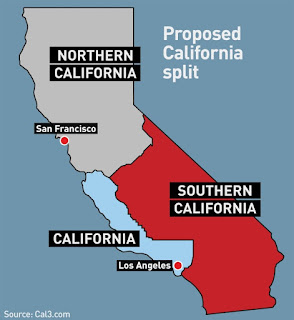
Split up California--Six Senators

I hate getting such poor representation, not in the quality of the people that California sends to DC, but in the diluted impact that my participation has in our highly fractured democracy. By my calculation, one third of me is represented by a US Senator. Is it my head, my belly, or my kneecaps?

The population of California is 39.24 million. The population of the other 49 states is 292.66 (the total US population is 331.9). California is about 11.5 % of the entire US population. We have 2 senators. The other 292.66 has 48. 


Not even considering the very small states that have two senators (let’s leave that out of the calculation--we can haggle later), using gross averages, 48 senators represent about 6 million people each. In California, each senator represents almost 20 million people. 


There are 435 voting members of the House of Representatives. California has 53 members, almost 12%. There are 42 Democrats and 11 Republicans. 


Ok so we don’t have proportional representation because the Founding Fathers had something else in mind, but with anything closer to proportional representation, we should have at least 6 senators. 


Given the highly partisan politics in the country and the obscene amount of gerrymandering, let’s get four more senators. Make California into 3 states. Two would be easy and has been often talked about. Given the huge urban vs rural/agricultural population split, there is a high chance of at least a few of the new senators from the Three-State-Split-Up California being Republicans. 


In 1787, three-fifths of each state's slave population was counted toward that state's total population to apportion the House of Representatives. Today, every Californian is counted as about 33% worthy of senatorial representation.

It's time to revisit the 2018 Cal 3 Proposal. Get us more senators.


Sunday, October 30, 2022

Going back to a year that might have changed my life

Yes and . . . 

Dear James, 

Your “Best Read on Jesus and His Message” was more than a quick summation of the Jesus sayings, miracle stories, resurrection narratives, including possible source materials, how they were collected, and the way the early church used them, including the split between the Jerusalem and the Greek/gentile communities. It is, from my understanding, pretty accurate. It might be a good jumping-off point if we are just looking to examine the impact of what comes down to us, for both good and ill, of the “Jesus Teaching.” I have to admit that it took me in another direction.


Can I tell you that your Unitarian training is showing? Let me chime in from the more liturgical Catholic point of view, even though I am definitely a former Catholic with little affinity left for ritual observance of any kind, even the spare Zen kind.


I’ll call this “Going back to a year that might have changed my life.”


This morning I find myself thinking about the year and half I spent at Dartmouth in the Religious Studies department. After I came back from France in 64, I decided that I would enter the Jesuits. I wanted to go to the novitiate right away, but my parents objected. I talked with the Newman Chaplin and decided to switch my major to Religious Studies. I’d written on the religious drama of Paul Claudel in France, and there were no majors in the department, so I worked out a split major. I spent my last full year taking every course given by a stellar faculty, the kind of top-level scholarship rarely assembled anywhere. Every day, Jacob Neuser, Hans Penner, Jonathan Z. Smith, Robin Scroggs, and a Belgian Augustinian who'd been a peritus at Vatican II and a visiting scholar directed my study. There were a few other students, so my classes were basically seminars. I wrote my senior thesis on the Prophetic Voice in the Christian church under Neusner. I was closest to Neusner. He liked me and encouraged me. His Judaism also came closest to how I held my Catholicism, faithful, open-minded, and inquisitive. I wrote to him several times over many years, and he always took the time to respond thoughtfully and generously.  


If it had not been 1965-66, the end of the Vatican Council, and if my deep personal bias is what most would label extremely liberal, I might have fallen in with some right-wing group like Opus Dei, though some might argue that the Jesuits could be classified as a left-wing cult. Regardless, I was cult material. Thank god I was more interested in what John Courtney Murray, Gus Weigel, and Hans Bea were up to. Throw in some Urs Von Balthasar, Hans Kung, Thomas Merton, mixed in a bit of Mircea Eliade, and you've got me theologically. Add hard drinking, avoidance of dealing, or even acknowledging my homosexuality, and you've got me personally. Looking back, I was extremely conservative, even defensive, sure that the Roman Catholic Church had all the answers, or at least kernels of “The” truth were there if you looked carefully, thoughtfully, prayerfully, and critically enough. 


My concerns, at least from a theological point of view, were reconciling the apparent discrepancies in the resurrection narratives. Jesus had to have been bodily resurrected into heaven. It all hinged on that. When Scroggs, I think, asked me how I handled the outlier report of the risen Jesus telling his disciples to go before him to Galilee, where he would ascend to heaven, I felt that there was either some misreporting or reporting a miscommunication. Further textual analysis would solve the mystery. Perhaps I really just had to learn Greek and/or Aramaic. 


Neusner had just published the first of the more than 900 books and articles he wrote during his stunning career: A Life of Yohanan ben Zakkai. Leiden, 1962. Ben Zakkai was a contemporary of Jesus and central to the creation of Rabbinic Judaism that took root in the diaspora after the destruction of the Second Temple in 70 CE. Ah ha, so Jesus was not a stand-alone figure in the religious turmoil of his era. Neusner was an amazing scholar. He’d studied the religious history of Palestine during the first century of the common era exhaustively. He said there was evidence of hundreds of wandering teachers like John the Baptist, Jesus of Nazareth, and Yohanan ben Zakkai populating the parched landscape. This estimate might be very conservative. 


Toying with the idea of converting to Judaism, I talked with Neusner. He was always the scholar, but he was an extremely approachable and friendly man. He cautioned me, ” The conservative Jewish position is quite cultural. Conversion does not work the way it does in Christianity. It usually happens when a Jew marries a Gentile, and the couple has to handle the day-to-day observance of the Law.” I was not going to get married, period, Jew or Gentile. My sense was that he had the confidence of a religious man that his particular faith tradition, let’s call it religious proclivity, provided some clues. He acknowledged that Christians had played a role in spreading the teachings of the Prophets worldwide. How’s that for endorsement of a religious belief system? I’m looking for the Messiah, and he says that Christianity would do as a promotion, including a byline, on the back cover of a particular understanding of the Law of Moses. Oddly at the time that was enough. He encouraged me to enter the Jesuits. He perhaps felt, or hoped that with the discipline of the Jesuits I might be able to become a scholar. He might have felt that truly mastering scholarship would unlock some of the questions that I wrestled with. 


Your quote from Robin R. Meyers about early Christianity is certainly provocative. “Consider this remarkable fact: In the Sermon on the Mount, there is not a single word about what to believe, only words about what to do and how to be. By the time the Nicene creed is written, only three centuries later, there is not a single word in it about what to do and how to be – only words about what to believe.” This not entirely true, or at least it's certainly misleading. First, the presupposition is wrong; very few of the parables in the narratives contain any doctrinal statements. Meyers has framed his "remarkable fact" for the spirituality vs religion crowd.  He says “only three centuries,” but neglects to say that those three centuries were as eventful as the last 75 years in terms of the rise and fall of religions and empires. But most importantly, he completely neglects the importance of the confession of faith amongst the early believers.


From the time of the very first churches, there was always emphasis on what you believed in and who you believed in. That was in fact the path to salvation. I was just reading an interview with Neusner. He was asked, "Why is dogma essential to orthodox Christianity and not to Judaism?" His response: “The main reason is that Christianity begins with the demand to believe in something or someone. There is a proposition attached to the beginning of the faith. You are saved through what you believe. This is certainly the message of Paul and the early church. Christianity stresses theology, not merely dogma in the sense of what one must believe, but theology in the sense of a systematic study of the faith and of the propositions of faith. The result of this is that the Christian, particularly the Protestant Christian, will think of religion in terms of faith.” 


I think that this is just a given. What was emphasized and what was neglected or changed is a parochial argument, but once you enter into a polemical conversation, it is part and parcel. If you take the position that the only course of understanding in Christianity is through discourse, however evenhanded, clear and logical, some residue of this trails along. It is the nature of the beast, intensified by the internecine bickering that was rampant in the early churches. 


It is also the key, not just backstory, for the Christian polemic that the life, death, and resurrection of Jesus was a singular, history-changing event. My own take on this has evolved over the years. It is a life-changing event in your history if it changes your life. That depends on you and you alone. I’ll let you call it grace if you include some qualifying statements. Personally, I’ve moved from Paul to Kierkegaard, but that’s another story.


This argument still doesn’t account for how the cult of Jesus, along with the corresponding cults of Mary, the saints, and the martyrs, came to capture the religious imagination of the West. Listening to the early writers of the gospels, it was proven by the reports of miracles and the resurrection of Jesus. I would venture that this is still the case in the vast majority of Christian religious communities today, or at least it’s in the general guidelines for membership. Listening to the church of religious science, in any of its forms, is the reason that it coincides with the nature of the human spirit, and according to most liberal theological thought, it is where our discourse lands us.


But for me, this does not come close to answering the question of how, among hundreds of itinerant preachers wandering in what we now call the Holy Land, did Jesus come to dominate the Western religious imagination? The believer says it's a statement of faith — that he was the son of God and it had to happen —but that’s a belief. I want to exert my personal prerogative to examine other possibilities.


I mentioned Jonathan Z Smith. The position at Dartmouth was his first as I recall, but even then he was working out the complex interactions of culture, ritual and belief. He scared me. After one seminar, because I was pretty resistant to his thesis, he looked at me and said, “If I lived in a culture that fostered a vibrant cult of Socrates, I’d be a follower.” Another time he said, “Christianity was the mystery cult that won.” Talk about provocative statements. But I remembered them. 


Let’s look at one of those propositions and see where it goes. In Zen, as things fall away, beliefs get challenged inside where they reside. Let’s look at the belief in Jesus dying and being resurrected as a kind of myth that may or may not have a lot of importance on many levels. It’s hard to be objective, but I have to acknowledge that several key elements of the pagan mystery cult are present. The god dies, and initiates share some of the god's aspects in a ritualistic manner, emerging with a part of the divinity. The sharing of bread and wine as a memorial of the sacrifice of Jesus in the communal rites of Christians, though probably very unlike what we know today as Mass, was practiced. You even have the separate entity of the primary god who presides over the unfolding of the mythic ritual, accepting the sacrifice of his son.


Information about mystery cults remains mysterious because they were secret. But they were rather widespread, so some of the details have become known. I find it interesting that much of our information comes from early church fathers who denounced them. They were not blind to the similarities. Membership was also sought after. It was also used as a way of social advancement. Early Christianity among the Gentiles was regarded as a religion of slaves.


I’m not citing any of this to either prove or disprove any of the tenets of Christianity. But if I were looking for a reason why the teaching of Jesus found fertile ground in Greco-Roman pagan culture, I would look here. There were hundreds of preachers with probably as many followers as Jesus, and who knows what they had to say about how to conduct your life. But the myth of Jesus’ sacrificial death and resurrection was planted in a culture that had a predisposition carved out by centuries of mystery cult initiations that went all the way back to early Egypt. It might have been the mystery cult that won. 


It took me more than 60 years to even entertain the possibility that Smith suggested. A few more and I’ll rewrite the Nicene Creed.


Your loyal reader