Search This Blog

Monday, September 25, 2023

Philip Asks Me the Big Question

 Was Phil as confused as he pretended to be? Or was he just being a wily old fox?


Mumonkan Case 2 
Hyakujô and the Fox 


Whenever master Hyakujô delivered a sermon, an old man was always there listening with the monks. When they left, he left too. One day, however, he remained behind. 


The master asked him, “What man are you, standing in front of me?” 


The man replied, “Indeed, I am not a man. In the past, in the time of Kashyapa Buddha, I lived on this mountain as a priest. On one occasion, a monk asked me, 'Does a perfectly enlightened person fall under the law of cause and effect or not?' I answered, 'He does not.' Because of this answer (For this answer evidencing a clinging to absoluteness), I fell into the state of a fox for 500 lives. Now, I beg you, Master, please say a turning word on my behalf and release me from the body of a fox.” 


Then he asked, “Does a perfectly enlightened person fall under the law of cause and effect or not?” 


The master answered, “The law of cause and effect cannot be obscured.” Upon hearing this, the old man immediately became deeply enlightened


It was Saturday morning. Only a few minutes remained until the last period of meditation ended. Zenshin was set to descend the stairs to the zendo and begin the ritual of opening the dharma. He was legally blind. It all required a lot of effort and planning. He was going to give a talk on this koan, Hyakujô and the Fox.


I was being his jisha and carried the incense. When we paused at the top of the stairs, he suddenly decided that he needed to check the exact wording of the old man’s question. Phil, another old man, could not make a mistake. He asked out loud, “Does a man of enlightenment fall under the yoke of causation or not?  What was his answer, yea or nay? What did it say exactly? Is the man free from Cause and Effect, or is he still trapped?” 


Then he asked me, “Check it out in the Mumonkan, will you?” But the tone of his voice sounded more like a command. He appeared agitated. He seemed to expect that I should have had some ability to find a particular case. “It’s very famous, he said. “It's in the Mumonkan. It must be on the shelf in the living room somewhere. It’s a very important case.” 


I have described his ability to find page, paragraph and sentence of an author he loved in his meticulously arranged library, but that morning, standing in the living room at Hartford Street, the books on the shelves were a total disorganized mess.


With the koans, or at least at that particular moment, my ability completely disappeared. When I eventually located the Mumonkan, he said he could not remember the case number, and he seemed to be blaming me for not supplying the missing information. Eventually, making us only a few minutes late, I read, 'Does a perfectly enlightened person fall under the law of cause and effect or not?' I answered, 'He does not.' 


Phil said, “Good. His first answer is no. Thank you.” Now he was prepared to open the dharma. I remember nothing about his talk. Questions tumbled over and over in my mind--not just is the enlightened man free from the law and cause and effect, but what exactly are we trying to free ourselves from anyway? What part of my life did I need to unyoke to be happy


A few years later I sat with this koan for days in the damp woods of Camp Meeker. When the sun came up till the day darkened, I thought of Phil, his blindness and his generosity. The wily old fox had given me a koan filled with indecision, red herrings, witchcraft and a few wrong answers, probably just traps or misdirections laid out with skill.  He told me that he thought he remembered it correctly, but he wanted to double check it. What was this puzzle that he had to get right? 


Philip was a man whose life, almost all of his waking life not occupied with meditation, was devoted to language and the written word. I can attest that words were his lovers, and he returned the favor. Now he couldn’t read at all anymore. He was almost completely blind and the reason was simply misdiagnosed glaucoma which would have been easily treatable. What a tragedy. If only a doctor had been able to give him the correct word for his blindness and not assigned some rare disease that only one a thousand get. Or if he had only gotten a second opinion when the highly recommended quack told him to kiss his sight goodbye. Maybe not as bad as 500 lives as a fox, but close.


Sometimes the law of cause and effect seems filled with random errors. Perhaps the law is quirky and poorly administered?  The koan says “The law of cause and effect cannot be obscured.” 


The zen Master says he's happy to have saved us all!


Phil’s verse:


HYMNUS AD PATREM SINENSIS

by Philip Whalen


I praise

 those ancient Chinamen

Who left me a few words,

Usually a pointless joke or a silly question

A line of poetry drunkenly scrawled on the margin of a quick

                      splashed picture—bug, leaf,

                      caricature of Teacher

on paper held together now by little more than ink

& their own strength brushed momentarily over it

Their world & several others since

Gone to hell in a handbasket, they knew it—

Cheered as it whizzed by—

& conked out among the busted spring rain cherryblossom winejars

Happy to have saved us all.


(Right. It's blurry.)


Sunday, September 24, 2023

Phil, dreaming of gummy bears, sees angels descending.

 The mind is a terrible thing to waste.


Now Phil was dying. Perhaps as long as a year before, he’d reached back for his chair, which wasn’t there, and fell, breaking his assbone. Thus began a slow decline. I was alarmed. It’s hard to say that a Zen Master, especially one that I loved, had given up on life, so I won't. But progressive blindness had stolen the delight of seeing words on a page, physical pain made the formal posture of zazen impossible, and now immobility obliterated the comforting routine of meditation, gabbing, study, jokes, and food. Not physical therapy with Baker Roshi’s student Joe Muscles, not Chinese food with taro root, not even gummy bears, could turn the tide. The ever-present good cheer, except when it suddenly disappeared, felt concocted. The veneer was wearing thin. I didn’t feel the bitter resignation of a person fed up with life. It was more a sense that he’d just had enough. He invited the dying to begin, and the invitation had been accepted. It would be long and slow.


Some sages claim that this was a good way for a meditator to die, as if waving a long slow goodbye to everything that had been assembled to make you--a precious death. In a way I feel that this is a bit like sticking a smiley face on a Hallmark condolence card. It masks the uncertainty of each piece tumbling into oblivion. Phil was always so kind to those who were helping him, but on the other hand he couldn’t hide the day to day frustrations. 


He would rail at the dying steps prescribed by Elizabeth Kubler-Ross, saying, "I have to decide if I’m at the bargaining stage or the resignation stage.” But he seemed to be following them exactly, or at least that was the framework that I carried into my conversations with him. I actually felt that he’d only taken baby steps away from the anger stage, but all that is extremely subjective. Perhaps I was still angry with him for ending the Maitri experiment, or screaming at me in the hallway, or harping on that old-time religion. 


Zenshin’s mind had always been clear as a bell, much clearer than his vision. His memory for words, phrases, even pages in a book, had been almost photographic. I wonder how much of this was compensatory.


Once, when I was entertaining some weird questions about presumed Kundalini energy in meditation, what Phil called the “squigglies,” he said, “Ol’ Luk Luk has something to say about that.  ”Middle case, third shelf, second from the left. (I think it was Charles Luk’s “Secrets of Chinese Meditation, but it might have been “Empty Cloud.”) Page 63, middle paragraph, beginning at the fourth sentence. That’s the interesting part. Read back to me. Then he gently told me that focusing on the heart might be good practice rather than chasing swirling whirling wisps of energy all over the place.


Another time when we were reading “Scenes from the Capital,” we got to a part where he talks about Gerald Manley Hopkins. He started to recite “The Windhover” not with his flat voice, not with his whimsical voice, but reverently, almost like plainchant. When he stumbled, he pointed to the first case, second shelf, 12th book from the right, page 43, “Just start reading.” 


  No wonder of it: shéer plód makes plough down sillion

Shine, and blue-bleak embers, ah my dear,

    Fall, gall themselves, and gash gold-vermilion.


When I was sitting with him in a bright room of the Zen Center Hospice on Page Street, he asked me, “Do you see them?”

“Who?”

“The angels.

“No actually, I don’t. Where are they?”

“Right there, floating around,” pointing towards the upper corner to the left of his bed.

“No, I still don’t see them.”

“Look, goddamn it.” His voice sounded plaintive, perhaps wistful.

“What do they look like?”

“Just like the ones on the Macy’s gift bags.”

I can’t see them, Phil. What would you like me to do?”

“Call the police, they’re reliable.”


Together, we looked. I could see nothing while at the same time I wondered where his mind had gone. The Mind is a terrible thing to waste, he used to joke. What mind? Here we were using what was left to search for angels.

The angels on the Macy’s bag too “Fall, gall themselves, and gash gold-vermilion.”


When he died I arrived late to the crematorium in South City, Baker Roshi read a line from one of his poems about delicious raspberries. Then we filed past, bowed and placed a raspberry in the plain box that held his body. 


Contrary to Zen custom, I visualized dumping buckets of crimson raspberries gashing gold-vermillion. I couldn’t stop myself.


Tuesday, September 5, 2023

August 6th, 1945, Carrying the Flame

This is a continuation of my earlier post about the movie Oppenheimer.

On July 31st of 1995, I drove with Maylie Scott from Berkeley over to Mayumi Oda’s house in Stinson Beach, just below Green Gulch Farm. I remember the day because it is the Feast of Saint Ignatius, and my friend Ty Cashman was living with Mayumi at the time. Ty was a friend who, like me, had been a Jesuit. Then we were both practicing Zen Buddhists.

The purpose of the visit was to receive a small flame that Mayumi had carried from the fire that burns at the Peace Memorial in Hiroshima, remembering the more than 140,000 innocent men, women, and children indiscriminately murdered on August 6th, 1945. There’s an eternal flame in the memorial park commemorating the 15 kiloton bomb that burned at 4000 degrees Celsius at its center. Mayumi had kindled a candle there and somehow secreted it aboard her plane back to the US. My job in the passenger seat of Maylie’s small car was to guard that flame on the bumpy and twisty road back to Berkeley. From there it would be carried to light the candles for a ceremony that would begin the blockade of the Livermore Lab. Maylie had organized the protest with the Buddhist Peace Fellowship to commemorate the 50th anniversary. She and several others would be arrested and spend several days in jail.

I mention the Jesuits because one of the main reasons that a number of Jesuits have become dedicated Zen Buddhist practitioners is the leadership and inspiration of Father Hugo Makibi Enomiya-Lassalle, and Father LaSalle was in Hiroshima on August 6th, 1945. He was walking on a hill above the city, about 6 or 8 kilometers from the epicenter and was injured although I have no clear information about the nature and extent of his wounds. Another very important Jesuit Pedro Arrupe was also close to the epicenter, leading a class for the Japanese Jesuit novices. The windows and doors of the building were blown out, but I couldn’t find any record of reported injury other than radiation poisoning, and I don’t know the extent. Arrupe went on to be elected as the General of the Society after the Second Vatican Council, and was the General during my years as a Jesuit. LaSalle became a student of Harada Daiun Sogaku Roshi, and after Harada’s death, he continued to work with the lay master Yamada Koun Zenshin Roshi, a relationship that lasted for the rest of his long life. There have been more than 10 Catholic religious who have been authorized as Zen teachers who came to the practice through LaSalle. That is an amazing accomplishment. I could say that all three of these men, Arrupe, LaSalle, and Yamada have had a profound personal impact on my life though I never met them. And so did the dropping of the bomb. I was just 1 year and 72 days old. I have lived under the shadow of annihilation for 78 years along with the rest of humankind.

A woman friend thought that the most appropriate response to the bombing might be retreat to a cave or dark church. In fact LaSalle created a zendo for the Jesuits and other religious who sat with him. It is still beside a flowing mountain stream above Tokyo and he named it Akigawa Shinmei Cave. There is an appropriate time for the silent grieving along with an inner search. Arrupe and his novices immediately sprang into action, went down into the streets of Hiroshima and began to look after the wounded and dying as best they could. I don’t know what my response would have been. I do know that when Maylie went to jail, it was a work day for me and I could not join the protest. Besides, someone had to make sure that Maylie’s aging mother was taken care of whilst her daughter was being arrested.

When my friend David Weinstein was sitting with Yamada in Kamakura, he remembers seeing Father LaSalle coming from Dokusan often in the early morning. One day he was standing with Yamada Roshi and they waved goodbye to LaSalle. Yamada turned to David, and said, “there is the man who is always teaching me how to apply the koans to life.”

Father LaSalle is buried in Hiroshima in other "hibakusha," survivors of the immediate conflagration. They are the front line in our fight to ban these weapons, and why it was so important for Maylie to carry that flame from Hiroshima to the Livermore blockade 50 years later..

Saturday, September 2, 2023

The End of The World as We Know It

And The End Period

Dasui Fazhen, "Shenzhao "
Case 29 Blue Cliff Record
Case 24 of The True Dharma Eye
Dasui and the Kalpa Fire

Some say the world will end in fire,
Some say ice.


If koans have consequences, I would label this case a supremely consequential koan. Can I approach the end right now? Traditionally, it is ascribed to a monk who lived in a hollowed-out tree and gave away tea at a roadside stand, and who, at least judging from the teachings that have come down to us as they are held in several competing schools, was almost obsessed with finishing up. He came from the area that is now Sichuan and lived just before what we now consider the Golden Age of Chinese Zen so he was a bit too early and a thousand miles too far north to make it to Chan sainthood. But for Mr. Dasui Fazhen, time and space were a secondary consideration.

The koan called “The Kalpa Fire” shows up at least three times in the collections, every time with a slight variation, showing that the end of Everything will be total and complete, even in the way we hold the question. The teaching goes deep and follows different streams.

In the Blue Cliff Record, a monk almost seems to be musing about the final conflagration of the universe and wonders if anything will be left. Will this too perish? “This perishes,” said Dasui. “If so,” persisted the monk, “does it follow the other?” “It follows the other,” said Dasui. Like night follows day, it will be entirely gone. Even night will no longer follow day. This could be the theoretical physicist’s answer.

In the version found in Andy Ferguson’s Zen's Chinese Heritage, the questioner monk refuses to hear the answer and goes off to consult another teacher who is able to turn his head around. The teacher tells Reverend Thick Head No End to rush back and apologize to Dasui. But by the time he arrived at Dasui’s hollowed-out tree, he had perished. The monk rushes back to Touzi Datong, who had set him straight, but, alas, by the time he arrives, Touzi had also perished. Perhaps he’s hinting that even the source of the teaching perishes along with everything else if I allow myself a metaphysical interpretation of the storyline. The theoretical is starting to take an existential twist, with perhaps a caution to listen to your teachers carefully.

Perhaps two hundred years later, when the story reaches Japan, Dogen does not let the questioner off the hook at all. In his version, Case 24 of The True Dharma Eye, the monk questioner asks Dasui: “Can you tell me if this very place will also be destroyed?”

Dasui said, “It will.”
The monastic said, “If so, will I be part of it?”
Dasui said, “Yes, you will.”

From an abstract, objective acceptance of the harsh reality that the reverse Big Bang will end up in oblivion, through the gratitude we owe to the teachers who had the courage to insist on the truth of the teaching, and the fact that they too are subject to the same law, it gets really personal: yes, you will also perish. Gone are the questions of time and space, past and future, and very distant future, so far out it is an abstraction I don’t really have to worry about, or certainly hope I don’t. In each moment, when the moment ends, how does it end, and how much does it carry over? Can I allow the moment to disappear in the fire of the kalpas and be free, and allow just what arises to come forth and support the next moment until it, too, no longer does.

Has Dasui served me a cup of Freedom Tea for free at his little stand?

Do I know enough to acknowledge a great man? Will I even know him? Someone asked Dasui, “What is the sign of a great man?” Dasui answered, "He doesn't have a placard on his stomach." Having thrown another wrinkle into the conversation, I will leave it at that.


Wednesday, August 30, 2023

Raksha Bandhan


Tradition bids me tie a ribbon on your wrist 

To say that you and I are related,

And it will always be

No matter what

What husband, what wife, 

what daughter, what son,

What lover, what friend,

May kisses, caresses

Abound.

May wounds be few.

No matter what,

There will be love.


What prizes and honors won, 

Include the ones you lost,

What joy, what laughter, 

what grief, what loss,

What trouble, what pain, 

what fear, what tear, what discovery, 

Embrace it freely.

In this moment

You are my world.


We are blood and yet so different

It makes no difference

What barrier, what fence

What wall, what boundary.

Cross, venture, explore,

A postcard now and then might be nice.

Calls are also cheap these days,

But neither is required.

I know there are only so many 

Seconds, minutes, years granted to us.

Use them as best you can.

As best we can.

I will try.


Make mistakes,

I will join you.

We are forgiven in advance.

You are encouraged to make as many as possible 

Unharmed or even injured.

Try to stay safe.

Continue please. 

You encourage me.


Forgive me if I have hurt you.

It was not intentional.

I know that I can be blind and careless.

You are also forgiven.


The world as we find it

Is a blessing.

You are part of my world.

Sounds trite

But it’s true.


Raksha Bandhan 2023

Saturday, August 26, 2023

The innocent world of the cloister—celibacy, sex and art

Alécio de Andrade, The Three Graces (1970)

December 15, 2008

I met Maylie Scott at the Center for AIDS Services, where she came twice a week under the guise of leading a writing group. I say, guise, not to ascribe any hidden motivation as if she were trying to convert the people she worked with to some Buddhist straight and narrow or any other hidden aim, but she was doing much more than teaching a creative writing course. She was a talented Zen teacher who had also been trained as a social worker. She was masterful. Our clients at the Center were drug addicts, some in recovery, some actively using; male, female and transexual sex workers; 50 or 60 gay men, pretty evenly split between middle-class white men and African American ghetto smart street kids. The glue that held the community together was that everyone was dealing with a disease that, in the mid-90s, was still a death sentence. They had a lot of their plates. In Maylie’s group they opened up and began to talk about themselves to a very sympathetic ear without a shred of judgment.

Maylie was a divorced single mom with three adult kids. Her big California brown shingled house on Ashby Avenue was part of the divorce settlement with her ex-husband, a Canadian English professor at UC. After her kids moved out there were several empty rooms. Her mother had just moved from a Manhattan apartment where she’d lived since divorcing Maylie’s father. It had been many years of living alone. Mary was close to 90. She could still take care of herself and was mentally very alert, but obviously living alone in a New York apartment was no longer workable.

Maylie was one of Mel Weitzman’s senior students. She’s been working with Mel for more than 20 years, but, with the exception of several practice periods at Tassajara, she’d never lived in a Zen center. She was looking to form a loosely knit community not organized around a practice schedule. She asked if I would consider moving in.

She invited me to join her and her mother for dinner so that I could meet her mother, and Mary got to give me her seal of approval. Mary was bright and curious to meet a potential new housemate. I’m sure that she wanted me to feel entirely at home as well as understanding the level of manners expected. When we sat down to dinner, there was a lovely silver napkin ring at my place. It was engraved in an antique script with the initials LBC. It would be mine. In thanking her, I asked who LBC was. Oh, she said someone in the family a generation back, Lawrence Baine Crandon. I said how lovely my grandfather was, Lawrence, and one couple among my parents' friends in Nichols, where we grew up, was Phil and Phyllis Crandon. Maylie was serving, but put down the spoon and looked at me with an impish grin, “We call him Uncle Phil, but he is really my mother’s first cousin. He is quite a character, don’t you think?” I tried not to act as surprised as I was. I said that all the kids loved to go to visit Randy, their son, where we snuck down into the basement where Phil had a very elaborate and expensive HO2 model train collection with tracks that wound around almost every available space.


Family with a Zen flavor.

This was the beginning of three very important years in my life. I finally began to allow myself to heal from the hidden personal costs of my work at Maitri Hospice, and I really began working with the koans, which enriched my Zen practice. All the while, Maylie, with her steady practice, was just there. She was lovely and so kind.

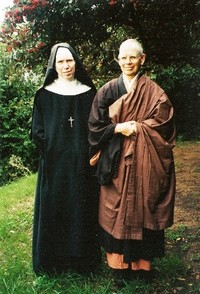
Sister Mary John Marshall and

Maylie Scott (Kushin Seisho)
I remember the day Maylie Scott’s sister, Sister Mary John, came to visit their mother, knowing it would be the last time. I had been told that I would be sharing the bathroom with an Anglican nun who had rarely seen a world outside the walls of the 13th century Benedictine cloister in the south of England where she had lived for more than 35 years, but I was not fully prepared when I got up to find the damp, coarsely woven material of a medieval habit neatly stretched across the rod for the shower curtain.

Mary John was cut from different cloth than the liberated religious that I had known in the heady days after John 23 had thrown open the windows at the Second Vatican Council. Sister Fayne RSCJ, for example, had gone to law school, taken the bar, and was living in a housing project in Washington D.C., advocating for the poor. A wonderful vocation, but worlds apart from that of Mother Mary John. She was also worlds away from the extraordinarily beautiful pianist whom I met while visiting a university with a highly regarded graduate program in music. She belonged to a religious order with a very liberal bent and had the heartbreaking proclivity of falling in love with sensitive young Jesuits.

I wondered how I would get on with Mary John. She told me that, yes, she had met gay men before, the priest who usually celebrated Mass for the sisters was a curate in a nearby parish in Kent and indeed he was gay. He was celibate, and she just seemed curious about same sex relationships, not at all judgmental. In the same way, she also wondered how the women of her congregation were going to deal with the situation of female priests. She had just been elected abbess of her congregation, and they had just accepted as a postulant a woman from Texas who had been ordained. Would a woman priest in their own community say Mass for them? It would take some getting used to, but her sisters seemed willing to be open to any genuine movement of the Spirit.

But for the most part our conversations were very ordinary. Did I want her to do any weeding in the rose garden? Yes, she did know of the new hybrids developed by Austin. They were lovely. For those few weeks she stayed with us, I became rather used to seeing a religious habit hanging over the shower curtain rod in the bathroom.

And when she left, I noticed that I had changed. Though our conversations had been rather brief for the most part, they were never guarded in some ways that I see in myself when talking with women. She seemed to be entirely relaxed with me. I did not pretend to be other than I am when I was with her, though during her stay, I did not have my boyfriend spend the night as a gesture of respect for her religious vows.

I talked with Maylie after her departure and, yes, Maylie felt something too. We tried to find the right word. Perhaps it was “innocent” or “naïve,” not as describing someone who has refused to be an adult, but rather someone who has maintained a quality of openness to the world and, through their attention to their inner states, cultivates a state of mind that is simple and focused.

And that innocence is what I find so lovely in the picture at the top of my post—the three women covered in religious habits are just gazing at three naked female forms, pagan goddesses actually, and the woman on the left is holding the hand of her sister. It is not sexual in any way—they are sharing a view of a world that they have renounced. It is very innocent, perhaps naive. Perhaps even "childlike" in the best sense of the word.


I was reminded of Sister Wendy Beckett, who did a wonderful series for public broadcasting about the great art displayed in the world's museums. When Wendy, standing in front of this painting by David Hockney, 'Peter Getting Out of Nick's Pool', said lightly, “Oh, David and his boys,” there was not a hint of judgment in her voice, and it allowed me to see the painting in an entirely different light—though not entirely asexual.

Friday, August 25, 2023

I have dinner with an Old Church Bishop

Hocus Pocus! My dinner with a bishop of the Old Catholic Church was right out of Buñuel.


I had dinner with the Bishop of the Western Diocese of the Old Catholic Church in America who, by chance or grace, had recently been transferred from a laundromat South of Market to a substantial house in the Forest Knolls section of San Francisco, west enough to be deep in the fog bank, high enough to be swept by the same winds that blew the fog down from Twin Peaks into the Castro.


Out of the Jesuits for less than a few years, I had moved to San Francisco and started my almost two-decade relationship with TR. We lived at Haight and Fillmore on the fourth floor. It was just about the time that I began venturing into the Castro; I was trying very hard to have as respectable a relationship as my mother would have approved of, which was, of course, totally impossible.


I had begun to lead groups in the 13-week version of the Fisher-Hoffman Process of Psychic Therapy. Money was very tight; we charged something like $400, perhaps as much as $500 for the 13-week session, and each one of the partners had 3-4 clients. I needed supplemental income.


Terry was a cook, and I was the night janitor at the Bakery Cafe, a hip eating place of “the new Castro” about 5 doors down from Harvey Milk’s Camera Shop. I would arrive at about 10:45 in the evening, just before closing. If I worked quickly, and the cooks had not spilled too much food on the floors, I could finish up between 2:30 to 3 AM, and would be headed home just about the time that the last of the forlorn cruisers would be tramping up and down Castro searching for a hookup. The scene was sexually charged even if a bit desperate and sad. It scared me a bit, but I tried to convince myself that it was part of our liberation movement.


Two brothers, one gay and one straight, had started their business in the neighborhood’s old Italian bakery. Looking over old floor plans that I found online, I remember the kitchen along the north wall just as drawn; the tables looked out into a well-kept garden. It was idyllic, maybe even a bit hippie. Later in its history, the space would grow in fame and notoriety as the Patio Cafe. New owners took out the antiquated baking ovens in a futile attempt to modernize the kitchen and bring it up to code. Along the way, they sacrificed the original name.


We had a general staff meeting once a week. At one meeting, a lawyer who was doing all the permitting work for the restaurant introduced himself, a smart, handsome man who assured everyone that he was straight. He then told us that he had only one testicle, but it was very large, could do the work of four, was very well proportioned, and not at all an embarrassment in the ritual of the California hot tub.


As we continued around the room with our introductions, not to be outdone by tales of a robust testicle, I volunteered that I had been a Jesuit for 11 years and was beginning a new career in the human development industry. The lawyer started to smile widely and, leaning into the table, told me that he was the Chancellor of the Western Diocese of the Old Catholic Church in America. I asked if he was ordained, and he responded that no, all that was required was a law degree plus good, or lucky, connections. Two of his clients, the owners of the notorious Slot Hotel South of Market, had discovered that the manager of the laundromat in the basement of their building was a legitimately consecrated bishop of the Old Catholic Church. I certainly cannot retrace the intricate web of intrigue that landed his excellency dead center in San Francisco’s gay leather community, other than one thing leads to another. A broke gay bishop made his way from Utrecht to San Francisco with thousands of other gay men and women; the owners of a gay hotel had used their influence in the Episcopal Church to find a liturgical slot in the crypt of Grace Cathedral for their wash-spin-dry bishop; my lawyer friend became the diocesan chancellor for the Old Catholic Church; and an extremely skeptical Jesuit night janitor was slated to dine with a successor of the Apostles at a posh address.


My second-hand orange VW Beetle was slightly out of place in the neighborhood, but I arrived on time, parked, and was led into a small dining room, with a few other guests. It was high church, pressed linen tablecloth, matching cutlery, bright glasses, and polished plates. We chatted until the bishop came downstairs in a flowing French-style purple soutane. It was beginning to feel like a Buñuel film. We were introduced and then stood uncomfortably for the recitation of a rote prayer. I was seated next to the bishop across from the chancellor. The bishop, with his very gay mannerisms, was almost a caricature, but I actually found him very engaging. He was not the brightest marble ever to don a miter, but there have been far worse.


He meandered through pretty mundane “getting to know you” kinds of questions. When he asked me several questions about my Jesuit training, I mentioned that I had been at Woodstock College in New York before coming to Berkeley. He smiled and asked, “Oh, do you know Frank D.?” Of course, I knew Frank, an extremely handsome Italian who was also gay. We were in the same year and had a close, hesitant relationship that included a lot of flirtation. I’d lost track of him during my years at the Berkeley Jesuit Seminary. I was stunned.


“I ordained Frank, and he’s now the Abbot of a small Benedictine monastery that I’m starting in Colorado.” Before I could say anything, he grabbed my hand and motioned for me to get up. “Do you want to talk with him?” In the seconds it took to mumble my assent, we were in the kitchen, and the bishop had taken the receiver off the wall phone and was dialing a number.


“Brother Frank, I have a surprise for you. Woodstock College, your class, here’s Ken.”


Then he handed the phone to me. Some awkward back and forth--we were both shocked--but in general a very friendly hello. From the whole exchange of words nearly 50 years ago, I remember one phrase quite clearly: “the bishop and I disagree about several things, but I love him.” I imagined that the monastery was for celibate monks and the bishop was more tolerant of same sex relationships than my gay Jesuit-Benedictine crush. Their love was not imagined.


Frank and I said goodbye with real heartfelt good wishes, and though I knew that I would soon lose track of him again, there was no regret. A sweet connection.


I never got to ask my question about the formula for the episcopal consecration that the Romans insisted the Anglicans got wrong and severed their connection to the Apostles. My Jesuit research had led me to the conclusion that it was a political move disguised in theological language. I suspect that the Bishop’s response would have been some reference to Utrecht. Formula, mode, substance might have been reduced to magic words, like hocus pocus. But he was far better than that. His instincts led him to uncover the hidden love between a man he’d made a priest and a stranger who’d appeared at his table, and this bishop followed his instincts.


The evening ended at 9. The bishop excused himself, explaining that he had to teach about the “Filioque Controversy,” and, because it dated from the 11th century, he had to brush up. It was at least important to know who said what, and what the consequences were. I thought that was a pretty solid theological procedure. Then he disappeared to probe the existence of the Holy Spirit, seeming to float up the stairs as lightly as he’d descended them. Could this have been a surreal sleight of hand with a touch of magic realism?


Some time later, maybe months, maybe years, I had some very pricey tickets to hear Gore Vidal in the Masonic Auditorium atop Nob Hill. I found a very tight parking space for the VW on Jones right behind Grace Cathedral, and, as I was rushing to my seat, I turned and looked through the glass door into the cathedral’s crypt. There was my laundromat bishop with full Roman-style miter and regalia at the end of a procession. I remembered that his Slot sponsors had found an altar and chapel for him, in exchange for ensuring that the fundamental line connecting the Apostles of Jesus to the Episcopal Bishop of San Francisco remained unbroken. I remember the coincidence of the two events quite clearly, though my timeline is foggy; if the event at the Masonic Hall was connected with Gore’s run for the Senate, the date of sighting the bishop might have been as late as 1982.


Could I be accused of gonzo journalism, as if I were writing a report of a spiritual night out while on dope or some New Age high? I stand accused. It really did happen, and Gore’s “Live from Golgotha” is far more gonzo than I can muster.


Tuesday, August 22, 2023

The Christian Church and Slavery

There have been many linguistic, cultural and anthropological studies about the origin of the Jesus narratives, but I am aware of none that explore how the teachings were shaped by the existence of the large populations of slaves in the ancient world other than to say that proportionally large numbers of slaves were undoubtedly members of the early communities, and that the teachings were not abolitionist.

The Roman census system was reasonably accurate. Taxes were assessed by population, and the Empire’s finances depended on it. In the Augustan census of 28 BCE, the number of Roman citizens, men, women, and children across the Empire was 4,063,000. To this number add about 2,000,000 slaves and some foreigners, making a total population of 5,500,000. Slaves were taxed, so the numbers are almost certainly underreported, but still, that calculates out to almost 30% of the population of the Empire were slaves at the time of Jesus. Other scholarly research puts the number of slaves lower, between 10 to 20% of the total population, but it is possible that as many as one in three persons were in bondage. 


The Roman Empire at this period of expansion was continually at war, and slaves were booty of war. The soldiers of defeated armies became prisoners who became slaves if they were not executed. Most I presume became gladiators. The civilian populations of defeated kingdoms were also subject to slavery. People from all walks of life, teachers, doctors, artisans and accountants became slaves as well as hairdressers, drivers and concubines. And according to the amount of freedom that their masters or owners allowed, these men, women and children might have become members of the Jesus congregations. We have no way of knowing how many, but what is certain is that there were many slaves in the early Christian congregations outside Jerusalem, particularly in the Roman port cities that Paul evangelized, but also in Rome as well. 


The word slave is found at least 127 times in 119 verses of the Greek versions of the New Testament. Doulos in Greek has only one accurate translation into English, which is slave. It is often rendered "servant" by many translators, but it literally means to be owned by someone for a lifetime. Unsurprisingly, Paul has the most to say about slavery. In Ephesians 6:5–8, Paul states "Slaves, be obedient to your human masters with fear and trembling, in sincerity of heart, as to Christ". Similar statements regarding obedient slaves can be found in Colossians 3:22–24, 1 Timothy 6:1–2, and Titus 2:9–10.  In Romans 1:1, Paul calls himself "a slave of Christ Jesus."


In the Pauline texts, a constant ethical teaching comes through: be a good slave if you are a  slave and treat your slaves well if you are the master. Rise up and throw off your master’s oppression was left for the Exodus or it died in the Sinai desert. There are many echoes of the prophets in the sayings and stories about Jesus, but any prophetic condemnation of slavery is muted if it exists at all. This is the reason why Martin Luther King reached back into the Hebrew Bible to find a rallying point for the anti-segregation movement, which he then coupled with the egalitarian teachings of the gospels. 

______________


The devil is in the details. My investigation of church teachings regarding slavery after Paul reveals a mixed record at best. Here is a summary of what I learned from articles on Wikipedia. I have only included information that could be found on at least two independent searches.


In the early years of Christianity, freeing slaves was regarded as an act of charity, but the actual institution of slavery was rarely if ever criticized. In 340, the Synod of Gangra condemned the Manicheans for urging that slaves liberate themselves; the canons of the Synod instead declared that anyone preaching abolitionism should be anathematised, and that slaves had a Christian obligation to submit to their masters. Augustine of Hippo renounced his early Manichean views. He argued that slavery did not belong to the natural state that Adam and Eve were born into, but that the institution of slavery was caused by human sin but allowed by God as a form of judgment. John Chrysostom argued that slaves should be resigned to their fate, that by obeying his or her master, a slave is obeying god. He also stated that slavery itself was the fruit of covetousness, of extravagance, of insatiable greediness. 


In the 15th century, most Popes continued to legitimize slavery, at least as a result of war. In 1452 Pope Nicholas V issued the papal bull Dum Diversas, which granted Afonso V of Portugal the right to reduce any "Saracens, pagans and any other unbelievers" to hereditary slavery. In 1488 Pope Innocent VIII accepted the gift of 100 slaves from Ferdinand II of Aragon and distributed them to the cardinals and Roman nobility. The Pope gave human beings, slaves, as gifts or Christmas presents! In 1639 Pope Urban VIII purchased slaves for himself from the Knights of Malta. On the other hand, a few Popes beginning in the 15th and 16th century denounced slavery as a crime, including Pius II, Paul III, and Eugene IV, but those voices were a minority. 


After the Council of Trent when Thomas Aquinas became the gold standard of Catholic moral teaching, the question about the legitimacy of holding slaves might have been settled. Look no further for its justification according to his Natural Law Theory in the Summa. He comments on this proposition from Aristotle: "It is clear, then, that some men are by nature free, and others slaves, and that for these latter slavery is both expedient and right" (1255a2-3), and that men "should seek to be masters only over those who deserve to be slaves" (1334a3). This is Aquinas’s comment: “Therefore, all human beings who differ from others as much as the soul does from the body, and as human beings do from irrational animals, are, because of the eminence of reason in them and the deficiency in others, by nature masters of the others. In this regard, Solomon also says in Proverbs 11:29: ‘The stupid will serve the wise.’” (Commentary 1.3.10). 


Thomas, who is not feminist by any stretch of the imagination, uses slavery to justify the subjection of women, and asserts that it is without sin: “Subjection is twofold. One is servile, by virtue of which a superior makes use of a subject for his own benefit, and this kind of subjection began after sin. There is another kind of subjection, which is called economic or civil, whereby the superior makes use of his subjects for their own benefit and good; and this kind of subjection existed even before sin.” (I, q.92, a.1, arg.2). 


If you are an abolitionist, there is little evidence of opposition to the institution of slavery in church history or the councils. You’ll have to look elsewhere for an argument to support your case. Slavery in different forms was allowed to exist within Christian moral teaching and practice for over 18 centuries, and with few exceptions, it was simply treated as part of the organization of human society. Something radically changed, however, with the massive and brutal exploitation of African populations to provide laborers for sugar and cotton plantations at the beginning of the industrial age.


Monday, August 21, 2023

No More a Slave

A Jesuit friend who teaches in Nepal mentioned almost casually in conversation that the young father who lives below his flat in Kathmandu with his newborn son had been a slave. He wasn’t exaggerating. He wasn't speaking metaphorically. He wasn’t lying. As hard as it is for most of my Western friends to grasp, slavery still exists. We might think of the sex trade, which has been documented and exposed in the international press, but people other than women and girls are still treated as physical property that can be bought and sold. The practice is far more widespread than we imagine.

Slavery is officially banned in all countries in the world; indentured servitude in India ended in 1920, but people have found ways around it. They always do. If there are statutes, for example, prohibiting harsh treatment or even execution of servants, they might be variants of English colonial law governing indentured persons or provisions in the Sharia. However, I doubt that most cases of involuntary servitude are even apparent. A hidden network of illegal or semi-legal arrangements has its own set of rules.

In my 6th year teaching English in northern India, I tutored a young man completing his secondary education at the Tibetan Children's Village, a school run by the Tibetan Government in Exile. My student, Bama, was almost 21. Most of his fellow students were 8-10 years younger. I was charged with helping him bring his English up to the 10th or 12th standard so that he could graduate and attend College in India. Bama was a very dedicated, bright student. It was a worthwhile investment.

He told me that the monks called him Bama because of the high esteem that they had for Barack Obama, and it was close to the English transliteration of his Nepalese name. He was descended from a class of Tibetan warriors that the Kings of Nepal at one point hired or captured on the tundra to be their royal guards, their Swiss Guard. He was ethnically Tibetan, and spoke Tibetan as well as Nepali, Hindi, and English.

As I did with all my beginning students, I asked him to tell me his story. He said matter of factly that he had been the property of an Indian family who lived close to the border with Nepal. I was shocked. We took out the Tibetan-English dictionary and checked the exact meaning of property. Yes, Bama said, they owned him in the same way that they owned their house, cars, or businesses. They were a prosperous merchant family who treated him well, but he was their slave and had been since he was a young boy.

When the family moved South to a small town outside Sera Jey Monastery near Mysore to start a restaurant, he was taken along as the dishwasher. He made friends with some monks who came to the restaurant regularly for Sunday brunch. His Tibetan is quite good. I know one was a rinpoche because I took his address to send money to pay for further English lessons. These monks decided to buy him out of slavery and begin his formal education. He was 15 or 16 at the time. I have no idea the actual cost of his freedom, but I do know it was expensive. I imagine some monks approached someone in the Indian family who owned Bama and began a negotiation. The monks dug deep into their reserves.

Not only did his status change when the monks adopted him—he was no longer part of a clandestine world of cheap labor—but there were also opportunities that had been closed off. He learned to read and write quickly. A whole world opened up, and he was grateful. I should note that there was no expectation on their part that Bama shave his head and begin monastic training, though I’m sure he would have been welcomed. It was a gift.

After the major earthquake in Nepal in April of 2015, the Dalai Lama became very concerned about Chinese influence in post-quake relief, and he wanted to get as many monks of Tibetan origin as possible out of Nepal. Bama still carried a Nepalese passport. He returned to Nepal and smuggled a group of 7 or 8 monks across the border into India. They didn't carry any passports but couldn’t use the border crossing designated for refugees from Tibet because of some bureaucratic technicality. He told me that this was one time he wore a monk’s robes, but he would not make it permanent. It was part of his returning the favor of finding his freedom. Bama had not heard MLK say, “No one is free until we are all free,” but he understood the maxim and lived it.

That is a real story of manumission that even includes an underground railroad, and it happened just a few years ago. But I have to admit that I found it unsettling. I had assumed that after our American Civil War and Eleanor Roosevelt’s inclusion of the Universal Declaration of Human Rights in the UN Charter, the question had been settled. But slavery has been around for as long as humankind has been defining civilized behavior. How could I be so naive?